How Long Does Trial by Written Declaration Take in California? (Real Timeline From Filing to Decision)
Short answer: A California trial by written declaration usually takes 60 to 120 days from the day you file to the day you get a decision. You get roughly four weeks to submit your TR-205 form, then the court has up to 90 calendar days to mail its ruling. If you lose, you have 20 more days to request a new trial.
You mailed your paperwork weeks ago. Now you’re checking the mailbox every day, wondering when the court will finally tell you whether you won. If you’ve chosen a trial by written declaration in California to fight your citation, the silence is the hardest part nobody warns you that no courtroom doesn’t mean no waiting. Below is the real timeline, built from California Vehicle Code 40902, Judicial Council rules, and how county courts actually process these cases.
What Is a Trial by Written Declaration?
A trial by written declaration is a legal process, created under California Vehicle Code section 40902, that lets you contest a traffic infraction entirely on paper. Instead of appearing in court, you submit a signed statement of facts on Judicial Council Form TR-205, along with any evidence. The citing officer submits their own declaration. A judge reviews both and mails a written verdict no hearing required.
Every California traffic court is required to offer this option for most vehicle code infractions. It’s one of the few legal proceedings in the state you can complete without ever missing a shift at work.
The Real Trial by Written Declaration California Timeline
Most guides give you a vague a few weeks to a few months. Here’s the actual trial by written declaration timeline, stage by stage.
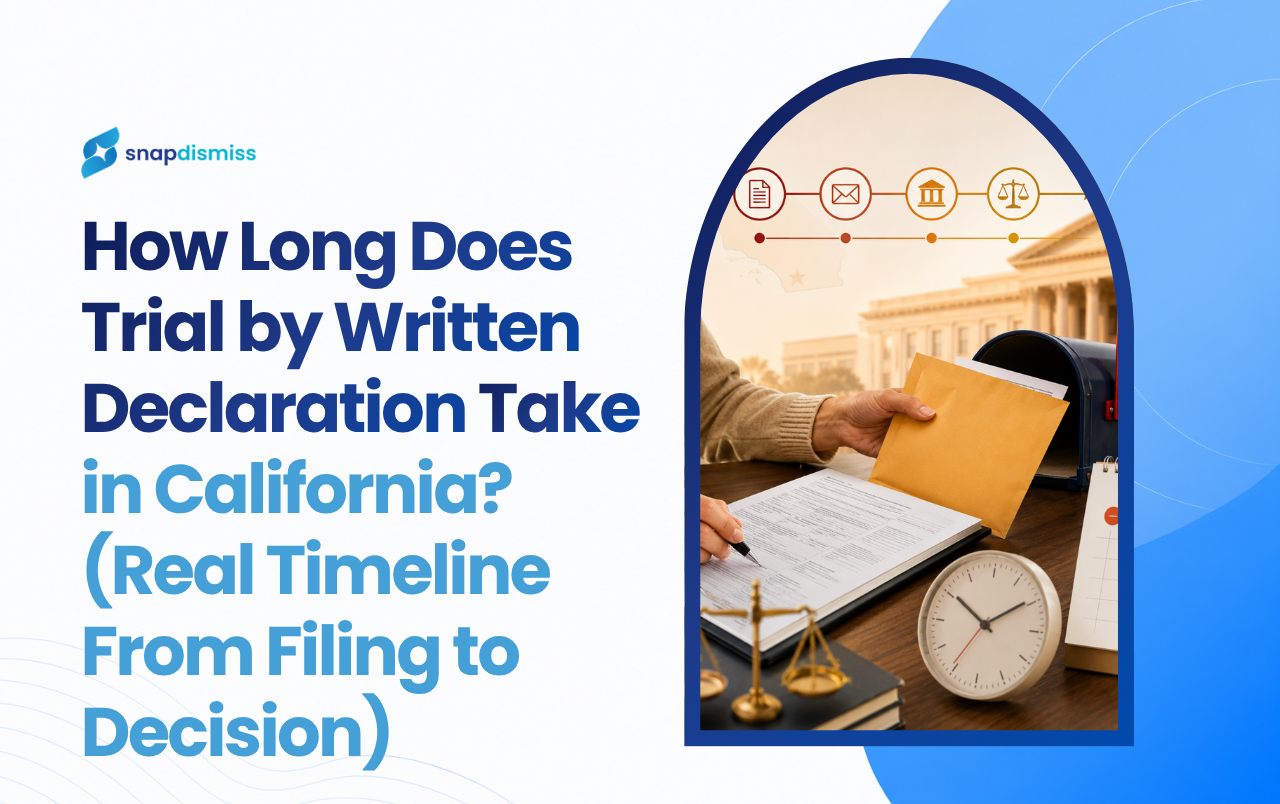
| Stage | What Happens | Typical Duration |
|---|---|---|
| 1. Request filed | You submit your request before the due date on your citation, often with a bail deposit | Day 0 |
| 2. Filing window opens | Court mails instructions and a shared deadline to you and the officer | 2–4 weeks |
| 3. Declarations submitted | You (and sometimes the officer) file your written statements by the deadline | By the assigned due date |
| 4. Judicial review | A judge reads both declarations and rules on the case | 30–90 days after the due date |
| 5. Decision mailed | You receive Form TR-215, the Notice of Decision | Within 90 calendar days (average 30–60) |
| 6. Trial de novo window | If found guilty, you may request a full new trial | 20 days from the mailing date |
Step 1: Requesting Your Trial (TR-205 Form California)
You must request your trial by written declaration on or before the due date printed on your citation. Some counties require the bail amount deposited at the time of your request; others process it through an online portal without upfront payment. Miss this date and you typically lose the option entirely, so this is the one deadline that can’t slip.
Step 2: The Filing Window (About Four Weeks)
Once your request is accepted, the court mails a packet with a shared submission deadline usually about four weeks out. This is where the actual trial by written declaration process happens: you write your statement of facts, attach photos or diagrams, and mail everything back before the cutoff.
Step 3: The Officer’s Declaration (Or Lack of One)
The citing officer is invited to submit a declaration defending the citation, but isn’t always required to. In a meaningful share of cases, the officer never files a response and no evidence against you means an automatic dismissal. This is one reason a written declaration can be a stronger option than a courtroom appearance.
Step 4: Court Review and Decision (30–90 Days)
After the filing deadline passes, a judge reviews the full file. California Rules of Court require the clerk to mail the decision within 90 calendar days of the due date. In practice, busier counties (Los Angeles, San Bernardino, Riverside) tend to run closer to that 90-day ceiling, while smaller counties often decide in 30 to 45 days.
Step 5: If You Lose Trial De Novo (20 Days)
A guilty finding on a written declaration isn’t final. Under Vehicle Code 40902, you have 20 days from the mailing date of the decision to request a trial de novo a brand-new in-person trial where the original declaration isn’t held against you. This built-in second chance is a major reason attorneys recommend this route over simply paying the fine.
Why California Traffic Court Timelines Vary by County
There’s no single statewide processing speed. A California traffic court timeline depends on court staffing, case backlog, and whether the county uses an online system like MyCitations. Rural counties with lighter dockets often issue decisions in 30 days; large urban courts with thousands of pending citations regularly take the full 90.
A Real Example Timeline
Consider a driver cited for going 15 mph over the limit on I-405 in Los Angeles County. She requests a trial by written declaration on the due date (day 0), receives her filing packet three weeks later, submits her TR-205 statement with a dashcam photo two weeks after that, and waits 68 days for the court’s decision not guilty, with a full bail refund. Total elapsed time: roughly 105 days from citation to dismissal, with zero court appearances.
Common Mistakes That Delay or Sink a Case
Most delays and losses when you contest a traffic ticket in California trace back to a handful of avoidable errors:
- Missing the request deadline filing even one day late usually forfeits the option entirely.
- Vague statements of facts “I wasn’t speeding” doesn’t hold up; specifics, measurements, and diagrams do.
- No supporting evidence photos, weather records, or vehicle maintenance logs strengthen a declaration significantly.
- Assuming silence means dismissal the case is still pending until a decision arrives; treat the due date as final until you have it in writing.
- Skipping the trial de novo window letting the 20-day appeal deadline pass locks in a guilty verdict permanently.
Expert Tips to Keep Your Case Moving
- File your request the same day you decide to fight the ticket every day counts toward the 90-day clock.
- Keep a copy of everything mailed, with tracking or certified mail confirmation.
- Write your statement of facts in plain, specific language: what happened, when, and why the citation doesn’t match the facts.
- Calendar the 20-day trial de novo deadline the moment you file don’t wait for the decision to arrive to think about it.
- If your court offers an online portal, use it; digital filings are generally processed faster than mailed paperwork.
Fight Your Traffic Ticket by Mail in California: Is the Wait Worth It?
For most drivers, yes. Choosing to fight a traffic ticket by mail in California trades a few months of waiting for zero missed work, no courtroom anxiety, and a built-in appeal if things don’t go your way. Compare that to a courtroom trial, which resolves faster but requires taking time off, appearing in person, and facing a judge directly.
Frequently Asked Questions
How long does trial by written declaration take in California?
Most cases take 60 to 120 days total: about four weeks to file your statement, then up to 90 calendar days for the court to mail its decision. Busy counties often use the full 90 days; smaller courts can decide in 30 to 45. Curious how long does trial by written declaration take compared to an in-person hearing? The written route is almost always faster once you factor in courtroom scheduling delays.
What is the TR-205 form used for?
Form TR-205 is the official Judicial Council document used to submit your written declaration for a traffic ticket. It includes your statement of facts, evidence list, and signature under penalty of perjury.
Can I check the status of my written declaration while I wait?
Some counties offer online case lookup tools; others require a phone call or in-person check with the clerk’s office. There’s no statewide portal, so check the instructions specific to your citing court.
What happens if the court misses the 90-day deadline?
The 90-day window is a strong administrative guideline, not an automatic dismissal trigger. Delays happen, especially in high-volume counties, but they don’t erase your citation your case remains pending until a decision is mailed.
What if I lose my trial by written declaration?
You have 20 days from the mailing date of the decision to request a trial de novo, a completely new in-person trial. The original written decision has no bearing on that new proceeding.
Is fighting a California traffic ticket by written declaration worth the wait?
For most infractions, yes. A California traffic ticket defense built on a written declaration avoids missed work, court anxiety, and attorney fees, while preserving your right to a full trial if you’re not satisfied with the outcome.
The Bottom Line
A trial by written declaration in California isn’t instant, but it’s predictable once you know the stages: a few weeks to file, up to 90 days for a decision, and 20 more days of appeal rights if you need them. Knowing this timeline in advance means no anxious guessing just a plan.
If you’d rather not draft your TR-205 statement of facts from scratch, Snapdismiss helps you fight your California traffic ticket with a court-ready declaration built in minutes from the details of your citation, so nothing in your filing slows down your case.
Sources: California Courts Self-Help Guide — Traffic, California Vehicle Code Section 40902, Judicial Council Form TR-205.