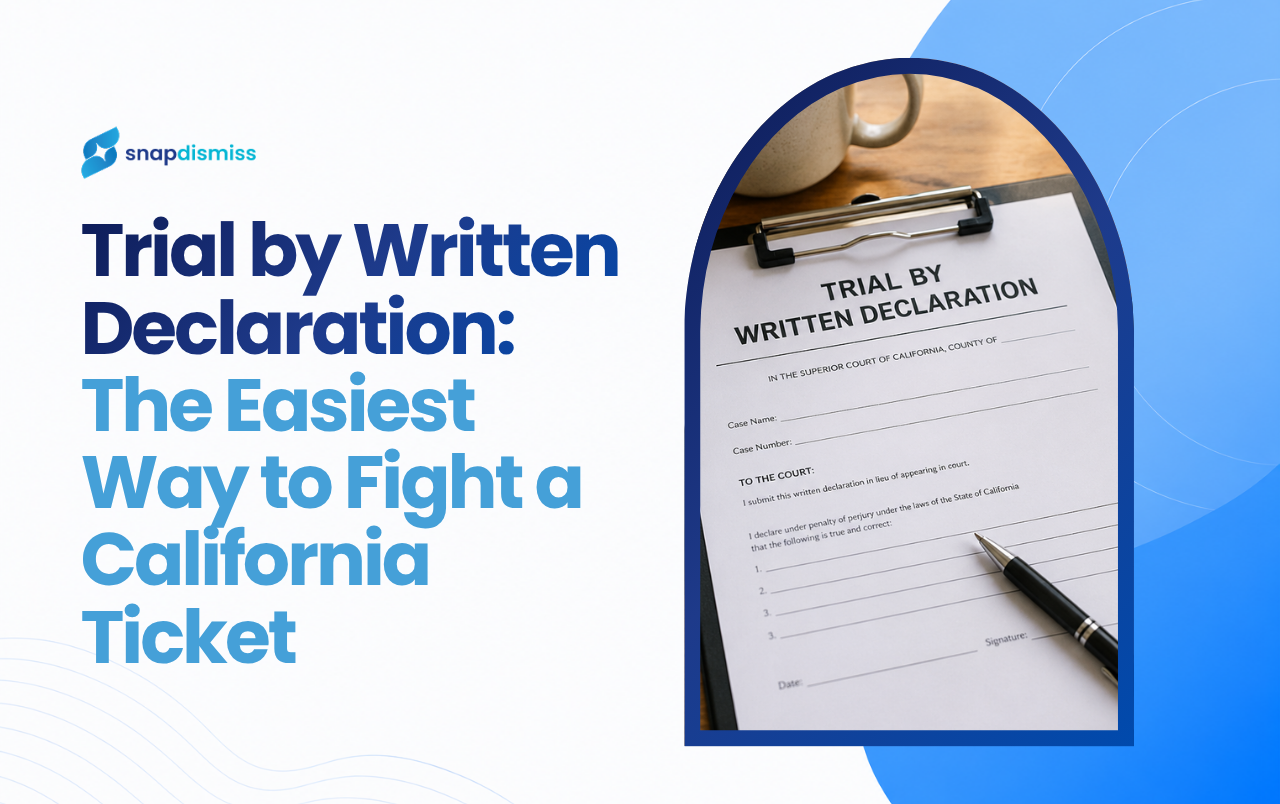
Trial by Written Declaration: The Easiest Way to Fight a California Ticket
What if you could fight your California traffic ticket from your kitchen table, on a Sunday afternoon, without missing a single hour of work and still have a real shot at getting it dismissed entirely?
That’s not a hypothetical. It’s called a Trial by Written Declaration and it’s the most powerful, most underused tool California drivers have. Under California Vehicle Code Section 40902, any driver charged with a traffic infraction has the legal right to contest that ticket entirely in writing. No courtroom. No judge staring you down. No officer looming across an aisle.
Just you, a form, your facts and a judge who reads both sides and mails you a decision.
This guide covers everything you need to know about the Trial by Written Declaration process in California: how it works, who qualifies, how to write a declaration that actually wins, and what to do if you don’t get the result you want the first time.
What Is a Trial by Written Declaration?
A Trial by Written Declaration (also called a Trial by Dec, or TBWD) is a California legal process that allows a driver to contest a traffic infraction entirely through written submissions no court appearance required.
Here’s the quick definition optimized for clarity:
A Trial by Written Declaration is a written traffic trial in California, authorized under Vehicle Code Section 40902, where both the defendant and the citing officer submit sworn written statements to a judge, who then makes a ruling by mail. If the officer fails to respond, the case is typically dismissed.
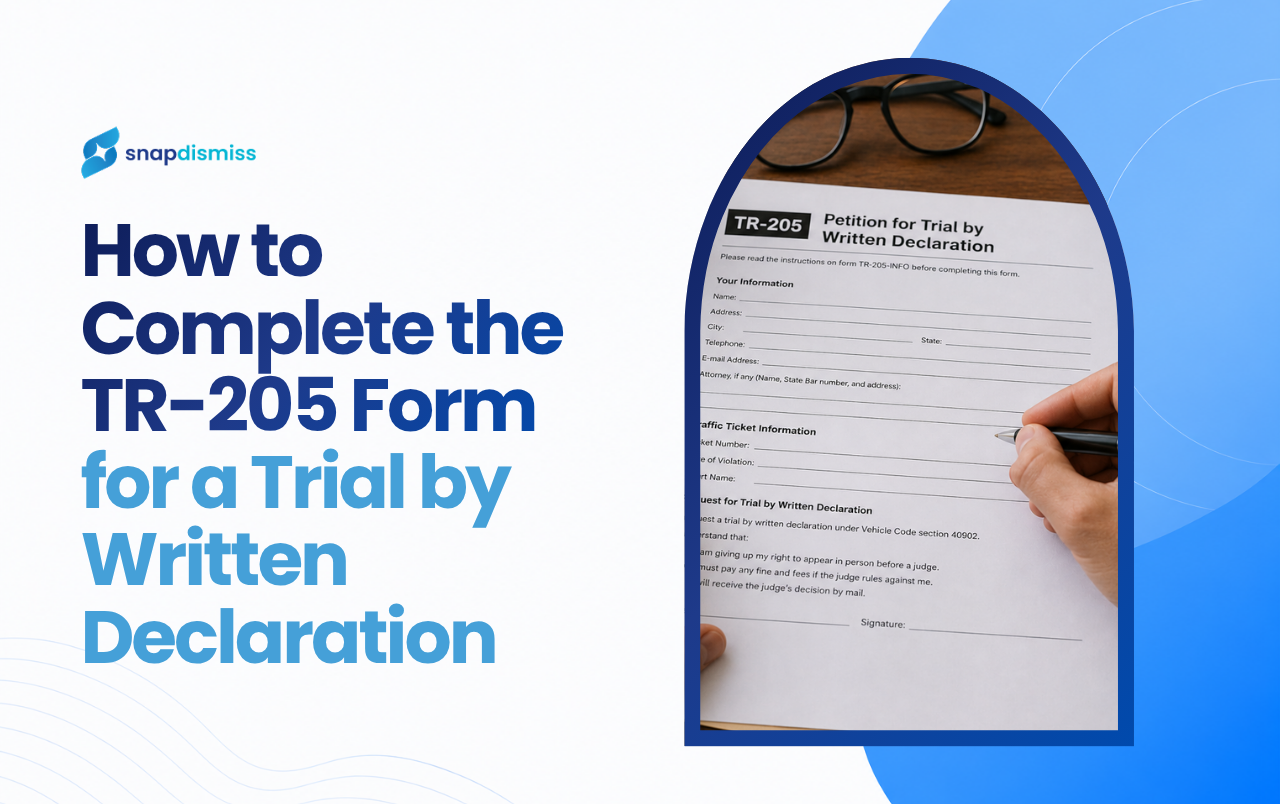
The process is governed by California Rules of Court, Rule 4.210, and the official form used is Judicial Council Form TR-205. It is the single most convenient way to fight a ticket by mail in California and it comes with a crucial safety net: if you lose, you get a second shot in person.
Why the Trial by Written Declaration Is Your Best First Move
There are four legitimate responses to a California traffic ticket: pay the fine, attend traffic school, contest by written declaration, or appear in person at trial. Here’s why the written declaration wins on almost every measure:
| Option | Court Appearance? | Can Win Outright? | Second Chance If You Lose? | Insurance Protected If Won? |
|---|---|---|---|---|
| Pay the fine | No | ❌ No guilty plea | ❌ No | ❌ No |
| Traffic school | No | ❌ No still a conviction | ❌ No | ✅ Point masked only |
| Trial by Written Declaration | No | ✅ Yes full dismissal possible | ✅ Yes Trial de Novo | ✅ Yes if dismissed |
| In-person court trial | Yes (required) | ✅ Yes | ✅ Appeal possible | ✅ Yes if dismissed |
The written declaration is the only option that gives you a genuine path to full dismissal without stepping foot in a courthouse and if it doesn’t work, you still haven’t lost anything. Your bail is held (not cashed as a fine), and you can immediately escalate to a live trial.
That combination zero court appearances, a real chance at dismissal, and a built-in backup plan is why every driver contesting a California traffic ticket should try this process first.
Who Qualifies for a Trial by Written Declaration in California?
Not every citation qualifies. Before you start preparing your declaration, confirm your ticket meets these requirements:
Eligible Violations
- Speeding CVC 22349(a), 22350, 22356, 22348
- Stop sign violations CVC 22450(a)
- Red light violations including camera tickets CVC 21453(a)
- Cell phone / handheld device use CVC 23123, 23123.5
- Unsafe lane change CVC 21658(a)
- Most standard moving infractions under the California Vehicle Code
Not Eligible Requires In-Person Appearance
- Any ticket marked “Must Appear” on the citation
- Misdemeanors (DUI, reckless driving, hit-and-run)
- Violations involving an accident
- Speeding over 100 mph (subject to the FAST program with mandatory DMV review as of late 2025)
- Non-traffic local ordinance violations
- Commercial driver’s license (CDL) holders for certain violations
Key check: Look for the words “Must Appear” anywhere on your citation or courtesy notice. If you see them that route is closed. If you don’t see them and your violation is a standard infraction, you almost certainly qualify.
How to Fight a Ticket Without Going to Court: The Complete TR-205 Process
Here is the full written declaration traffic ticket process, broken into clear, actionable steps:
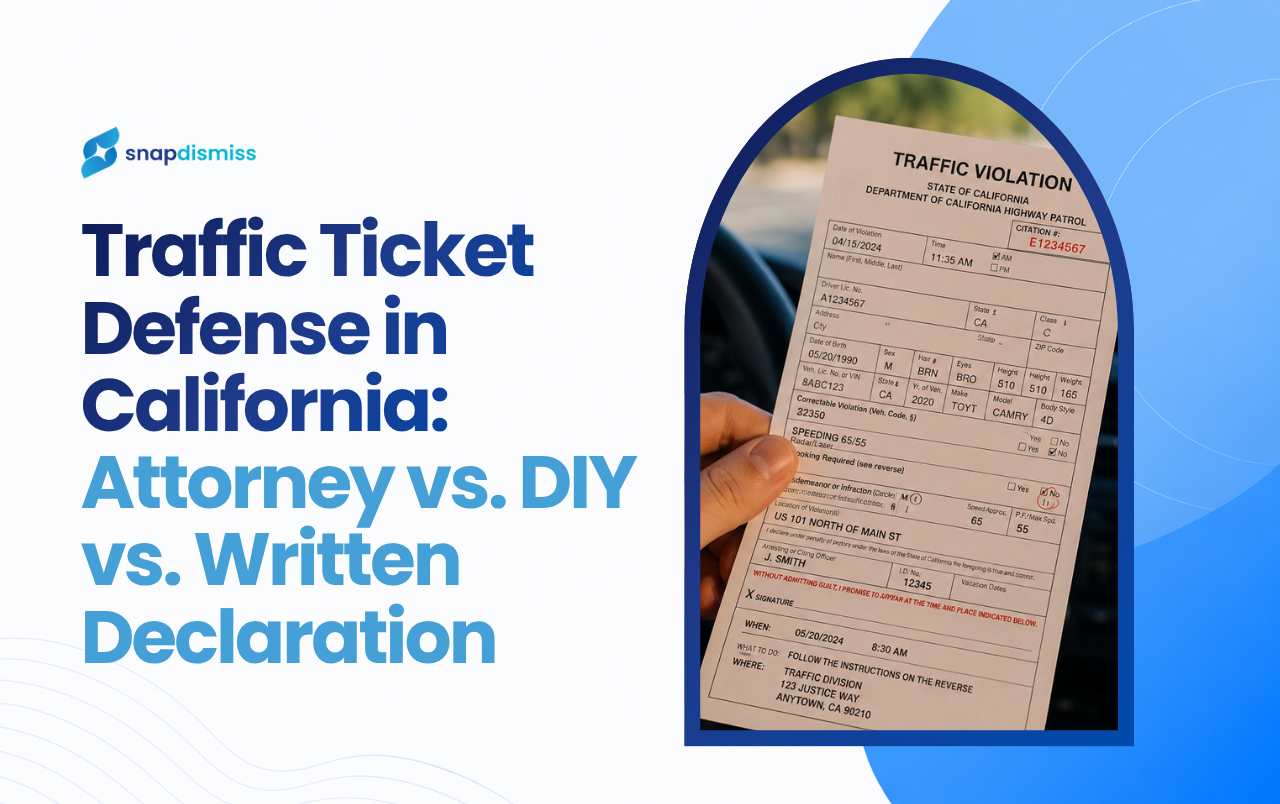
Step 1: Read Your Citation Completely
Before anything else, extract four pieces of information from your ticket:
- The specific Vehicle Code section you’re alleged to have violated
- The court handling your case (this is where you’ll mail everything)
- Your due date this is the hard deadline for all filings
- The detection method noted by the officer (radar, LIDAR, pacing, visual estimate, camera)
Step 2: Plead Not Guilty and Request a Trial by Written Declaration
Before your due date, contact the court in writing to:
- Formally plead Not Guilty
- Request a Trial by Written Declaration under CVC 40902
- Ask for Form TR-200 (Instructions to Defendant) and Form TR-205 (the declaration form)
Many courts now allow you to request this online or by mail. Some courts mail you the forms automatically when you request a not-guilty plea. Check your specific court’s website for their preferred procedure.
Step 3: Post Bail
You must submit the full bail amount (equal to the fine amount on your ticket) along with your TR-205. Critical distinction: this is bail, not a fine payment. It is held in trust by the court and refunded if you win.
Warning: Most courts do not accept bail by credit card. Submit bail by check, money order, or cashier’s check made payable to “Superior Court.” Write your citation number and “Not Guilty” in the memo line. If you accidentally pay online via the court’s payment portal, you may be paying the fine and closing the case as a conviction.
Step 4: Write Your Declaration of Facts (The Most Important Step)
The Statement of Facts section on Form TR-205 is where your case is won or lost. This is a sworn legal document everything you write must be true, precise, and directly relevant to the legal elements of your violation.
Structure your declaration like this:
- Opening identification: state your name, citation number, violation date, and your plea: Not Guilty
- Chronological facts: describe the road conditions, weather, traffic, visibility, and signage at the exact time and location
- Defense argument: reference the specific Vehicle Code section and identify which required element the prosecution cannot prove
- Evidence references: if you’ve attached photos or diagrams, name them explicitly: “As shown in Exhibit A, the speed limit sign was obstructed by foliage”
- Closing request: formally ask the court to find you Not Guilty and refund your bail
If you need more space, use Form MC-031 (Attached Declaration) as a continuation. Witnesses can also submit signed statements on MC-031.
Step 5: Assemble and Submit Your Complete Package
Your full submission must include:
- Completed, signed Form TR-205
- Any continuation pages on Form MC-031
- All evidence exhibits, clearly labeled (photos, maps, diagrams, dashcam screenshots)
- Any witness statements on MC-031
- Bail payment by check or money order
Mail everything to the court clerk’s address listed on your TR-205 form via certified mail with return receipt requested. This creates a paper trail proving timely delivery essential if any dispute arises later.
Timing tip: Submit no earlier than one week before your due date. Submitting too early can create confusion in court processing. Submitting too late means automatic forfeiture. A 5–7 day window before the deadline is the sweet spot.
Step 6: Wait for the Court’s Decision
After receiving your package, the court notifies the citing officer, who has a set deadline to submit their own written declaration. A judge then reviews both statements and all evidence and mails the ruling typically within 30–90 days.
Here’s the underappreciated reality: many officers simply do not respond. Between competing workloads, time off, agency transfers, and the sheer volume of citations, a significant number of written declaration cases are dismissed simply because the officer fails to submit their statement on time. When that happens, the judge has no prosecution evidence to weigh and dismissal follows.
Step 7: Act on the Decision Within 20 Days
You will receive a Notice of Decision (Form TR-215) by mail. Two outcomes:
- Not Guilty / Dismissed: Full bail refund issued. No point added to your DMV record. No conviction reported to your insurer. Case closed in your favor.
- Guilty: You have exactly 20 calendar days from the mailing date of TR-215 to file a Request for New Trial (Form TR-220) for a Trial de Novo a completely fresh in-person trial before a different judge, with new evidence allowed.
Do not let that 20-day window expire. It is the single most forfeited right in California traffic court.
What Happens at a Trial de Novo (Your Second Shot)
If your written declaration results in a guilty finding, the Trial de Novo is your backstop and it’s a powerful one. Under CVC Section 40902(d), this new trial starts completely fresh:
- A different judge hears the case with no reference to the written declaration
- You can bring new witnesses and new physical evidence
- The citing officer must appear in person if they don’t show up, the case is dismissed on the spot
- You can cross-examine the officer directly for the first time
By the time a Trial de Novo is scheduled often three to six months after the original citation an officer’s recollection of a routine traffic stop has naturally faded. Combined with your documented evidence and a prepared defense, this stage produces a significant number of dismissals.
The 7 Most Common Written Declaration Mistakes (And How to Avoid Them)
These errors destroy otherwise winnable cases every day across California courts:
- Paying the court’s online portal thinking it’s bail: it’s almost always the fine. Paying online closes the case as a conviction. Bail must be submitted separately, by check, alongside your TR-205 package.
- Writing an emotional narrative instead of a legal argument: “I had a good reason to speed” is not a defense. “The officer’s visual estimate was made from a stationary position on a curved road with limited sight line, making the cited speed impossible to accurately observe” is a defense.
- Missing the traffic school backup request: in many courts, if you want to retain traffic school as a fallback option after a guilty verdict, you must request it within your TR-205 submission. Fail to note it and you may lose the option entirely.
- Not photographing the scene immediately: signage changes, foliage gets trimmed, road markings fade. Photos taken the week you received the ticket are your strongest evidence. Wait three months and the scene may look completely different.
- Mailing without certified tracking: if the court claims they never received your package and you have no proof of delivery, your case defaults. Always use certified mail with a return receipt.
- Using an unofficial or downloaded form that isn’t TR-205: the court requires the official Judicial Council form. Any other format risks rejection on procedural grounds.
- Forgetting the 20-day Trial de Novo window: this is the most forfeited right in California traffic law. Set a calendar reminder the moment you receive any guilty verdict.
Expert Tips for Writing a Stronger Declaration
- Lead with the law, not your story. Identify the Vehicle Code section, then state specifically which element of the violation the evidence fails to establish. Judges respond to legal precision, not personal narratives.
- Request discovery before filing. When you plead not guilty, submit a written request to the court for the citing officer’s notes, the speed detection device’s maintenance and calibration log, and any dashcam or bodycam footage. Gaps in these records become your defense building blocks.
- Label every exhibit explicitly. Don’t attach a photo and assume the judge will understand its relevance. Write: “Exhibit A is a photograph taken on [date] at [location], showing that the posted speed limit sign is partially obstructed by overgrown vegetation, making it not reasonably visible to eastbound traffic.”
- Keep the tone formal and factual. No sarcasm, no complaints about the officer, no emotional appeals. Courts rule on evidence, not sympathy. A dry, precise, legally grounded declaration reads as credible. An emotional one reads as desperate.
- Use AI tools to maximize precision and speed. Platforms like SnapDismiss are built specifically for this process. Enter your citation details, and the platform identifies the strongest legal defense points for your exact violation code generating a court-ready TR-205 declaration in minutes, not hours.
Quick Reference: Forms You Need for a Trial by Written Declaration
| Form | Purpose | When You Need It |
|---|---|---|
| TR-200 | Instructions to Defendant explains the entire process | Read first, before anything else |
| TR-205 | Request for Trial by Written Declaration your main filing | Submit with bail by your due date |
| MC-031 | Attached Declaration continuation space and witness statements | When TR-205 space runs out, or for witnesses |
| TR-215 | Notice of Decision court’s ruling mailed to you | Arrives 30–90 days after submission |
| TR-220 | Request for New Trial (Trial de Novo) | Within 20 days of TR-215 if found guilty |
How SnapDismiss Makes the Entire Process Faster and More Effective
Writing a legally sound declaration from scratch researching your Vehicle Code section, understanding what must be proven, structuring arguments, and formatting correctly is the kind of work that takes most drivers hours. And most of them still get it wrong.
SnapDismiss automates the hardest parts. The platform is purpose-built for California drivers contesting traffic citations through the Trial by Written Declaration process. Here’s what it does:
- Instant eligibility check: confirm in under two minutes whether your citation qualifies for TR-205
- Violation code analysis: the AI identifies the specific legal elements that must be proven for your violation and finds where the prosecution’s case is weakest
- Court-ready TR-205 declaration: generated in minutes, formatted correctly, legally precise, and ready to print and mail
- Deadline tracking: no more mental-noting of due dates. SnapDismiss tracks your deadlines automatically
- Trial de Novo guidance: if your written declaration doesn’t succeed, the platform walks you through requesting your second trial
Start your eligibility check with SnapDismiss it takes under two minutes, and it could mean the difference between a $4,000 mistake and a dismissed ticket.
Frequently Asked Questions: Trial by Written Declaration in California
What is a Trial by Written Declaration in California?
A Trial by Written Declaration is a legal process under California Vehicle Code Section 40902 that allows drivers charged with traffic infractions to contest their ticket entirely in writing. The driver submits Form TR-205 with a sworn statement and evidence; the officer submits their own statement; a judge reviews both and mails a decision. No courtroom appearance is required.
Can I really fight a traffic ticket by mail in California?
Yes, completely. The Trial by Written Declaration process is specifically designed for this. You mail your completed TR-205, evidence, and bail payment to the court clerk before your due date. The entire process, from filing to receiving the judge’s decision, happens through the mail. Some courts also accept electronic submissions through the MyCitations portal, though note that using MyCitations may waive your right to a Trial de Novo if you lose.
What happens if the officer doesn’t respond to my written declaration?
If the citing officer fails to submit their written declaration by the court’s deadline, the judge typically has no prosecution evidence to weigh and the case is dismissed. Your full bail is refunded, no point is added to your DMV record, and no conviction is reported to your insurer. Officer non-response is one of the most common reasons written declaration cases resolve in the driver’s favor, particularly in high-volume courts where officers have competing demands on their time.
How long does the Trial by Written Declaration process take?
From the date you submit your TR-205 and bail, the court typically takes 30 to 90 days to issue a decision by mail. Busier courts particularly in Los Angeles, Orange County, and the Bay Area often take closer to the 90-day end. If you then request a Trial de Novo, add another one to three months for the in-person hearing to be scheduled. The entire process, from citation to final resolution, can run four to six months.
Is bail the same as paying the fine?
No, and this distinction is critical. Bail is a deposit you submit to the court to initiate the written declaration process. It is held in trust and refunded if you win. The fine is a payment that constitutes a guilty plea and closes the case as a conviction under California Vehicle Code Section 40903. Never pay through the court’s online payment portal if you intend to contest that is almost always the fine, not the bail.
What is a Trial de Novo and how is it different from an appeal?
A Trial de Novo is a completely new in-person trial in the same court, before a different judge, where you can present new evidence and witnesses. The written declaration is treated as if it never occurred. An appeal, by contrast, sends your case to a higher court for review of legal errors there is no new evidence and no retrial. For traffic infractions, the Trial de Novo is almost always the better path because it gives you a genuine second chance at full dismissal rather than a narrow procedural review.
Does fighting a ticket by written declaration affect my right to traffic school?
Not automatically but you must protect that right proactively. Many California courts require you to request traffic school eligibility within your TR-205 submission itself. If you lose the written declaration and hadn’t noted this request, the court may deny you the traffic school option. Always include a traffic school request as a backup clause in your declaration, even if your primary goal is full dismissal.
Can SnapDismiss handle the TR-205 process for me?
Yes. SnapDismiss is an AI-powered California traffic defense platform that guides you through the entire Trial by Written Declaration process. It checks your eligibility, identifies the strongest arguments for your specific violation code, generates a complete court-ready TR-205 declaration, and tracks your deadlines. The entire process takes minutes, and it’s designed for drivers who want a professional-quality defense without hiring a lawyer.
Start Your Trial by Written Declaration Today Before Your Deadline Passes
You now have the complete picture. A Trial by Written Declaration is not a loophole, a hack, or a long shot. It is a fully legal, court-sanctioned process that California built specifically to give every driver a fair chance at contesting a traffic citation without the burden of a courtroom appearance.
You can do this entirely by mail. You can win outright. If you don’t win the first time, you get a second live trial. And if you use the right tools, the whole process takes less than a morning.
The only thing that can stop you is the deadline on your citation.
Check your eligibility with SnapDismiss right now. Two minutes is all it takes to find out if your ticket qualifies and if it does, your court-ready defense package is waiting.
Disclaimer: This article is intended for general informational purposes only and does not constitute legal advice. California traffic law varies by court and jurisdiction. For advice specific to your situation, please consult a licensed California attorney. See the full SnapDismiss disclaimer for details.