No Court. No Lawyer. No Problem. How to Fight Your Ticket by Mail

You can fight ticket by mail in California without stepping foot in a courtroom, hiring an attorney, or taking a single day off work. It’s a legal right most drivers never use, and it works. This guide shows you exactly how.
What Does Fight Your Ticket by Mail Actually Mean?
When most people get a traffic ticket, they see two options: pay it or show up to court. Both feel painful. But there’s a third path one that lets you contest your traffic ticket entirely by mail, from home, on your own schedule.
In California, this is called a Trial by Written Declaration. It’s a formal legal process under California Vehicle Code Section 40902 that allows any eligible driver to dispute a traffic infraction in writing without appearing in court, without hiring a lawyer, and without the stress of standing before a judge.
You submit your case. The officer submits theirs. A judge reviews both in writing and makes a ruling. If the officer doesn’t respond and that happens more than most people realize you win by default.
Quick Answer: Fighting a ticket by mail means submitting a written defense (called a Trial by Written Declaration) to the court instead of appearing in person. In California, this is your legal right for most traffic infractions.
Who Qualifies for a Trial by Written Declaration in California?
Before you start, confirm your eligibility. Most California drivers qualify but there are a few conditions.
| Requirement | Details |
|---|---|
| Ticket Type | Must be an infraction (not a misdemeanor or felony) |
| Bail Amount | You must pay the full bail (fine) upfront before filing |
| Deadline | Must file before your court appearance date |
| Court Jurisdiction | Must be in a California court that accepts written declarations |
| Prior Plea | You must not have already entered a plea in court |
Common ticket types that qualify include speeding tickets, stop sign violations, cell phone tickets, red light camera citations, and lane change infractions. DUIs, reckless driving, and misdemeanors do not qualify.
Not sure if your ticket qualifies? Read this before contesting your California traffic ticket.
Why Fighting a Ticket by Mail Actually Works
This isn’t wishful thinking there’s a structural reason why fighting a traffic ticket in California by written declaration is so effective.
Officers Often Don’t Respond
Law enforcement officers handle hundreds of citations every month. When a written declaration arrives, they’re required to write their own counter-declaration. Many simply don’t they miss the deadline, forget, or deprioritize it. When that happens, the case is dismissed automatically.
The Burden of Proof Is on the Officer
In traffic court, you’re presumed not guilty. The prosecution must prove the violation occurred beyond a reasonable doubt. A well-crafted written declaration introduces enough doubt to shift the outcome in your favor without you ever having to argue face-to-face.
You Have Nothing to Lose (Literally)
Here’s the safest part: if you lose the Trial by Written Declaration, you can still request a De Novo trial an in-person hearing where the case starts fresh. You paid your bail upfront, so no additional money is at stake when you file. You can only improve your outcome, never worsen it.
Step-by-Step: How to Fight Your Traffic Ticket by Mail
Here’s the complete process for contesting a traffic ticket by mail in California:
Step 1: Confirm Your Eligibility and Deadline
Look at your ticket. Find your court appearance date. You must file your written declaration before that date. If it’s passed, call the court and ask for an extension courts often grant them.
Step 2: Pay Your Bail (Fine) in Full
This is a required step that surprises most people. You must pay the full bail amount to the court before they’ll process your declaration. Don’t panic if you win, you get a full refund. If you lose, the bail converts to your fine.
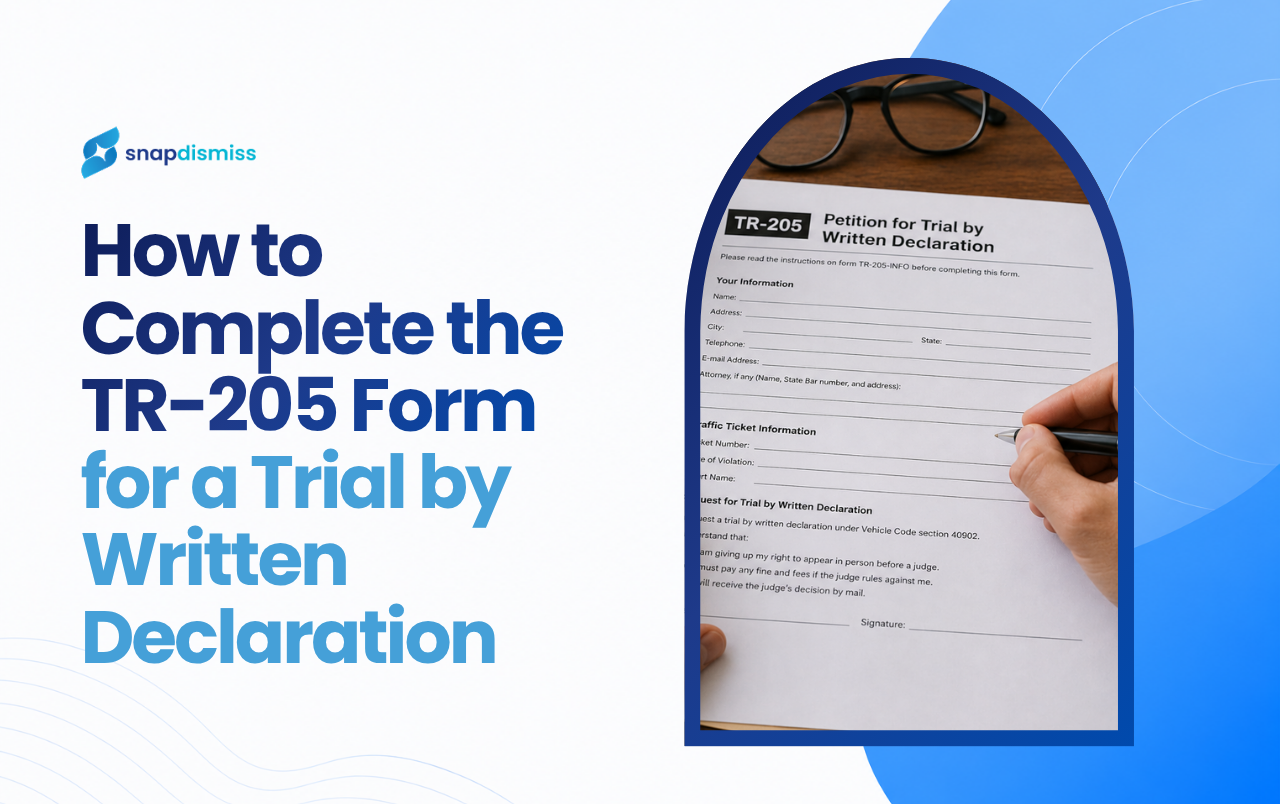
Step 3: Request or Download Form TR-205
Form TR-205 is the official California Judicial Council form for a Trial by Written Declaration. You can get it from your court’s website, in person at the clerk’s office, or by generating a complete, pre-filled version using Snapdismiss’s AI-powered TR-205 generator.
Step 4: Write Your Statement of Facts
This is the most important part of the entire process. Your Statement of Facts is where you tell your side of the story clearly, factually, and strategically. See the full guidance in the section below.
Step 5: Attach Supporting Evidence
You can attach documents, photos, screenshots, maps, dashcam stills, or any other evidence that supports your case. Label each attachment clearly and reference them in your declaration. Strong evidence turns a borderline case into a dismissal.
Step 6: Sign and Submit
Sign your TR-205 form under penalty of perjury. Submit it to the court by certified mail (recommended, so you have proof of delivery) or in person at the clerk’s window. Keep a copy of everything you submit.
Step 7: Wait for the Ruling
The court will notify you of the outcome by mail. Processing typically takes 4–8 weeks. If you win, your bail is refunded. If you lose, you still have the right to request a De Novo trial within 20 days.
How to Write a Winning Statement of Facts
Your Statement of Facts can make or break your case. Completing the TR-205 form correctly requires more than just filling in blanks the Declaration of Facts section is where your defense lives or dies.
What to Include in Your Declaration
- Exact time, date, and location of the alleged violation
- Road and weather conditions at the time
- Your specific actions and why they were lawful or necessary
- Any contributing factors: unclear signage, obstructed view, traffic flow, medical necessity
- Challenges to the officer’s vantage point or measurement accuracy
- Your clean driving record (if applicable)
What to Avoid
- Admitting fault even partially (“I may have been going a little fast but…”)
- Emotional language or appeals to sympathy
- Attacking the officer’s character
- Irrelevant information that dilutes your core argument
Pro tip: Write your declaration in the third person if it helps you stay objective, then convert it back to first person before submitting. Distance creates clarity.
7 Mistakes That Kill Written Declarations (And How to Avoid Them)
Most failed declarations come down to the same avoidable errors. Don’t let these sink your case:
- Missing the deadline. This is the #1 reason declarations are rejected. Mark your court date the moment you get your ticket and build in time to prepare.
- Not paying bail first. Courts won’t process your declaration without it. Check the exact amount on your ticket or the court’s website.
- Vague or generic statements. I don’t think I was speeding doesn’t work. Be specific, factual, and precise.
- Admitting partial guilt. Any acknowledgement of the violation even accidental can end your case. Frame everything as a denial of the officer’s account.
- Forgetting to sign under penalty of perjury. An unsigned declaration is invalid. Double-check every signature line before you mail it.
- No supporting evidence. A declaration alone is weaker than one backed by photos, maps, or dashcam footage. Attach everything relevant.
- Wrong court address. Declarations sent to the wrong address get lost. Confirm the exact mailing address with the court before sending.
Expert Tips: What Actually Moves the Needle
Based on real California traffic ticket defense experience and driver outcomes, here’s what consistently produces results:
Challenge the Equipment, Not the Officer
For speeding tickets, ask for the calibration records of the radar or LIDAR gun used. Officers are required to have them if they can’t provide documentation that the equipment was properly maintained and calibrated, the reading becomes inadmissible. This alone has dismissed thousands of tickets.
Cite Specific Vehicle Code Sections
Look up the exact California Vehicle Code section listed on your ticket. Read the precise language. Sometimes the elements of the offense require conditions that simply weren’t met in your situation. Citing the code in your declaration shows legal literacy and precision.
Use Google Street View as Evidence
If you’re arguing that a sign was obstructed, a crosswalk wasn’t clearly marked, or sightlines were limited, a screenshot from Google Street View can support your account and it’s a timestamped, third-party source the judge can verify independently.
File During High-Volume Periods
Officers are statistically less likely to respond to written declarations during holidays, summer months, or periods of department-wide training. Timing your declaration strategically isn’t dishonest it’s smart.
How Snapdismiss Makes This Effortless
Writing a strong Trial by Written Declaration takes research, precision, and knowledge of what actually works in California courts. Most drivers spend hours on it and still aren’t sure if they’ve done it right.
Snapdismiss eliminates that uncertainty.
Snapdismiss is an AI-powered platform built specifically for California traffic ticket defense. You answer a few questions about your ticket, your situation, and your evidence and Snapdismiss generates a complete, court-ready TR-205 form with a professionally written Statement of Facts tailored to your specific violation.
- Court-formatted TR-205 generated automatically
- AI-written Declaration of Facts based on your unique case
- Built-in legal strategies matched to your violation type
- Evidence checklist so you submit the strongest possible package
- Guided submission instructions so nothing gets missed
No legal background required. No attorney fees. No guesswork.
Thousands of California drivers have used Snapdismiss to dismiss their tickets from $300 speeding citations to $600 cell phone violations. The process takes less than 15 minutes.
Frequently Asked Questions
Can I fight any traffic ticket by mail in California?
You can fight most traffic infractions by mail using a Trial by Written Declaration. This includes speeding tickets, stop sign violations, cell phone tickets, and red light camera citations. Misdemeanors and DUIs do not qualify. Check your ticket if it’s listed as an infraction and has a bail amount, you’re almost certainly eligible.
What happens if I lose my Trial by Written Declaration?
If you lose, your pre-paid bail converts to your fine but you owe nothing additional. You also retain the right to request a De Novo trial (in-person hearing) within 20 days of the ruling. This means you can fight your ticket twice before exhausting your options.
How long does a Trial by Written Declaration take?
After you submit your declaration, most courts rule within 4–8 weeks. Some courts take longer during high-volume periods. You’ll receive the result by mail at the address on file.
Do I need a lawyer to fight my ticket by mail?
No. A Trial by Written Declaration is specifically designed for self-representation. You do not need an attorney, and hiring one is rarely cost-effective for standard traffic infractions. AI tools like Snapdismiss provide the strategic edge that would previously have required legal expertise.
Will fighting my ticket affect my insurance?
If your ticket is dismissed which is the goal no points are added to your driving record, and your insurance company is never notified of the violation. If you simply pay the ticket, the conviction appears on your record and can trigger premium increases that cost you far more than the fine itself.
What is Form TR-205?
TR-205 is the official California Judicial Council form required to request and submit a Trial by Written Declaration. It includes your personal information, the citation details, and most critically your Statement of Facts. You can download the blank form from the California Courts website or generate a fully completed version using Snapdismiss.
Can I fight a red light camera ticket by mail?
Yes. Red light camera citations in California are infractions and are fully eligible for Trial by Written Declaration. Camera-based tickets are actually some of the best candidates for this process because officers rarely submit counter-declarations for automated citations leading to a high rate of default dismissals.
Ready to Fight Back Without Setting Foot in a Courtroom?
You now know exactly how to fight ticket by mail in California. You understand the process, the pitfalls, and the strategies that actually work. The only question left is: are you going to use them?
Every day you wait is a day closer to your deadline. Every ticket you pay without fighting is money you didn’t have to spend and points you didn’t have to take.
Snapdismiss handles the hard part for you. Our AI builds your complete TR-205 declaration in under 15 minutes court-ready, legally precise, and optimized for dismissal based on your specific ticket.
No court date. No lawyer. No problem.
Disclaimer: This article is for general informational purposes only and does not constitute legal advice. Individual circumstances vary. For advice specific to your case, consult a licensed California attorney. See the full SnapDismiss disclaimer for details.