How to Contest a Traffic Ticket in California Without Missing a Deadline

Here’s a fact that surprises most California drivers: missing your traffic ticket deadline can cost you more than the ticket itself. A $238 speeding citation can balloon past $600 with a single missed date and once that happens, your options to actually fight the ticket shrink dramatically.
The good news: California gives you a clear, manageable path to contest a traffic ticket in California without ever missing that deadline as long as you understand exactly what the date means, what your extension options are, and how to use the time you’re given strategically.
This guide breaks down every deadline you’ll encounter, how to request more time when you need it, and the exact process to file your contest before the clock runs out.
What Is the California Traffic Ticket Deadline, Exactly?
The due date printed on your citation or on the courtesy notice mailed to you afterward is the date by which you must take one of three actions: pay the fine, request traffic school, or formally contest the ticket. It is not a suggestion. It is a hard legal deadline that determines whether you keep your right to fight the citation at all.
Here’s where most drivers get confused: the due date on the original citation is often not your final deadline. Many California courts mail a separate courtesy notice 30 days or more after the citation, which can include a different (and sometimes later) due date. Always check the most recent notice you’ve received, and if you haven’t received one within 30 days of your citation, contact the court directly.
What Actually Happens If You Miss the Deadline
Missing your due date doesn’t just delay your case it triggers an escalating chain of consequences, each worse than the last:
| Consequence | Detail |
|---|---|
| Civil assessment | Up to $300 added automatically to your fine under California Vehicle Code Section 40508.5 |
| Failure to Appear (FTA) | An additional charge added to your case can escalate to misdemeanor exposure |
| DMV hold | The court can notify the DMV, triggering a hold on your driver’s license renewal |
| Registration hold | A hold placed on your vehicle registration renewal |
| Collections referral | Your unpaid fine may be sent to a collections agency |
| Bench warrant (rare but possible) | In some cases, a warrant may be issued for failure to appear |
A $238 speeding ticket can become $600 or more after a single missed deadline before any insurance impact is even factored in. This is precisely why understanding your deadline options matters as much as understanding your legal defenses.
How to Request a Deadline Extension Before You Ever Risk Missing It
This is the single most underused tool in California traffic defense: nearly every county allows you to request an extension on your due date for free, often without appearing before a judge.
Here’s how it works and what to expect:
- Contact the court before your due date by phone, online portal, or in person. Most courts will not grant extensions after the deadline has already passed.
- Typical extensions run 30 days, though some counties allow up to 60. San Diego County, for example, permits up to two 30-day extensions per case without appearing before a judicial officer. Santa Clara County allows one extension, capped at 30 days past the due date.
- There is usually no fee to request an extension.
- Online portals (like MyCitations or county-specific systems) often allow you to request extensions instantly without a phone call.
Critical clarification: An extension delays your due date it does not erase the ticket, reduce the fine, or remove points. What it does is buy you the time to properly prepare a Trial by Written Declaration defense instead of rushing one together the night before your original deadline.
Many experienced defenders use exactly this strategy: request the extension first, then use the extra weeks to build a stronger, evidence-backed declaration. There is nothing improper about using the time the court grants you it’s a built-in part of the process.
The Complete Timeline: Contest a Traffic Ticket in California Without Missing a Step
Here’s exactly how to move through the California ticket dispute process without ever risking a missed deadline.
Day 0 The Day You Receive the Citation
- Write the due date on your calendar immediately, with a reminder set for one full week before it.
- Read the citation completely note the Vehicle Code section, court name and address, and detection method used.
- Photograph the scene if you intend to contest. Conditions change fast.
Days 1–7 Decide Your Path
Decide whether you’ll pay, attend traffic school, or contest. If you need more preparation time, this is the window to call the court and request an extension well before the deadline, when courts are most likely to grant it without question.
Before Your Due Date (Original or Extended) File Your Plea
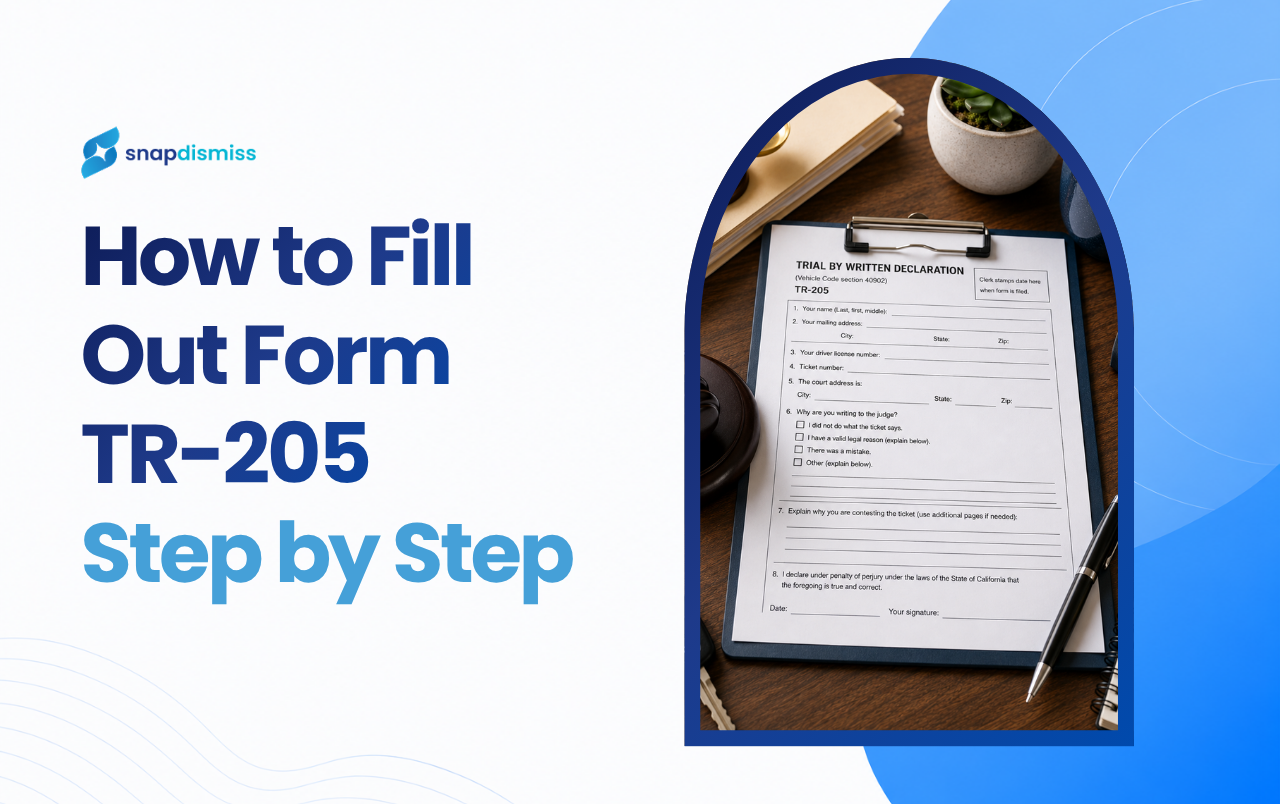
Contact the court and formally plead Not Guilty, requesting a Trial by Written Declaration under California Vehicle Code Section 40902. Request Forms TR-200 and TR-205 if you haven’t received them. Submit your discovery request for the officer’s notes and detection device records at the same time.
5–7 Days Before Your Filing Deadline Submit Your Complete Package
Mail your completed TR-205, your Declaration of Facts, labeled evidence exhibits, and bail (by check or money order) via certified mail to the court’s mailing address. Submitting a few days early protects against postal delays without creating the confusion that comes from mailing too far in advance.
If writing the Declaration of Facts feels overwhelming, SnapDismiss’s TR-205 generator builds a complete, court-ready, violation-targeted declaration in under 10 minutes eliminating the time pressure that causes most missed-deadline panic in the first place.
30–90 Days Later Decision Arrives by Mail
The court mails a Notice of Decision (Form TR-215). If dismissed, your bail is refunded and the matter is closed. If found guilty, a new and equally strict deadline begins immediately.
Within 20 Calendar Days of a Guilty Verdict File for Trial de Novo
This is the deadline drivers miss most often precisely because they assume the process is over after a guilty verdict. It isn’t. Under CVC Section 40902(d), you have exactly 20 calendar days from the mailing date of your decision to file Form TR-220 requesting a Trial de Novo a brand-new in-person trial with new evidence allowed. This deadline is absolute and non-extendable. Set your calendar reminder the moment you open the envelope.
Camera Citations Have Their Own Deadline Rules Don’t Assume They Match
If your citation came from a red light or speed camera, your deadline mechanics differ from an officer-issued ticket in important ways:
- Camera citations must be mailed within 15 calendar days of the alleged violation under CVC 40518 if your Notice of Violation arrived later than that, this alone may be grounds to challenge the citation.
- The response deadline is printed directly on the mailed notice it does not follow the same arraignment schedule as an officer-issued ticket.
- Some camera programs (including newer speed camera pilot programs) include a separate administrative review process with its own timeline, distinct from the traditional court deadline.
Always read your specific notice carefully rather than assuming the standard officer-issued deadline structure applies.
Real Scenario: How a Missed-Deadline Panic Turns Into a Strong Defense
A driver receives a speeding citation with a due date 18 days away. Work travel eats up the first two weeks, and by the time they sit down to deal with it, only four days remain not enough time to gather evidence or write a real declaration.
Instead of rushing a weak submission or letting the date pass, the driver calls the court and requests a 30-day extension granted the same day, with no fee and no court appearance. That extra month is used to return to the citation location for photos, submit a discovery request for the radar calibration log, and build a properly targeted Declaration of Facts referencing the specific elements of CVC 22350. The result: a complete, evidence-backed submission filed well within the new deadline instead of a rushed, weak one filed in a panic, or no submission at all.
This is the exact strategic value of understanding deadline mechanics before you need them.
7 Deadline Mistakes That Cost Drivers Their Right to Contest
- Assuming the original citation date is final. A later courtesy notice may have a different deadline. Always check the most recent document you’ve received.
- Waiting until the last few days to request an extension. Many courts deny extension requests made less than five days before the due date. Request early.
- Assuming an extension changes the outcome. An extension only moves the date it does not reduce the fine or remove points. You still need to file a contest or pay within the new window.
- Confusing payment with contesting. Paying even partially through the court’s standard online portal is typically treated as a guilty plea, not as bail for a written declaration.
- Forgetting the 20-day Trial de Novo deadline. This is the most commonly missed deadline in the entire process, precisely because drivers assume a guilty verdict ends their options. It doesn’t but the window is short and absolute.
- Applying officer-issued ticket deadline assumptions to camera citations. Camera tickets follow different notice and response timelines. Read your specific notice.
- Ignoring the ticket entirely while hoping it goes away. Courts do not forget. Ignoring a citation triggers the full escalation chain civil assessment, FTA, DMV hold, and potential collections automatically.
Expert Tips for Managing Every Deadline in Your Case
- Calendar every deadline the day you receive any court document. Citation due date, extended due date, TR-205 filing deadline, and the 20-day Trial de Novo window if applicable all four deserve their own calendar entry with a reminder set a week ahead.
- Request your extension in writing, even if you do it by phone first. A written record email or letter protects you if there’s ever a dispute about whether or when you requested more time.
- Use your extension period productively, not just as a delay. The extra 30 days exist for evidence gathering, discovery requests, and declaration writing not procrastination. Build your defense during this window.
- Confirm your new deadline in writing before relying on it. Ask the court to email or mail confirmation of your extended due date so there’s no ambiguity later.
- If you’ve already missed a deadline, act immediately rather than waiting. Contact the court right away to ask about setting aside the civil assessment for good cause, or to understand your remaining options. The sooner you act, the fewer additional penalties accumulate. For a complete walkthrough of how to fight a traffic ticket in California from home, even after a setback, see our complete guide.
How SnapDismiss Keeps You Ahead of Every Deadline
SnapDismiss was built around exactly this pain point: drivers who know they should contest their ticket but run out of time to do it properly. Here’s how the platform helps you stay ahead of every deadline in your case:
- Instant eligibility check: confirms in under 2 minutes whether your citation qualifies for written declaration, so you’re not wasting time researching eligibility while your deadline approaches
- Rapid declaration generation: a complete, court-ready TR-205 package built in under 10 minutes, dramatically reducing the prep time that often causes drivers to blow past their due date
- Automatic deadline tracking: for your original due date, any extension you’ve secured, and the critical 20-day Trial de Novo window
- Trial de Novo guidance: clear next steps the moment a guilty verdict arrives, so the 20-day window never catches you off guard
The single biggest reason drivers miss their chance to contest isn’t lack of a legal right it’s lack of time to prepare properly before the date closes. SnapDismiss compresses that preparation time from hours to minutes.
Frequently Asked Questions: California Traffic Ticket Deadlines
What is the deadline to contest a traffic ticket in California?
The deadline is the due date printed on your citation or courtesy notice typically issued within 30 days of the citation. You must plead Not Guilty and request a Trial by Written Declaration, or otherwise respond, by this date. Missing it triggers a civil assessment of up to $300, a possible Failure to Appear charge, and a hold on your DMV record.
Can I get more time before my traffic ticket deadline?
Yes. Most California courts grant at least one extension typically 30 days for free, often without requiring a court appearance. Some counties, like San Diego, allow up to two 30-day extensions per case. You must request the extension before your original due date; most courts deny requests made within the final few days.
What happens if I miss my traffic ticket deadline in California?
Missing your due date triggers a civil assessment of up to $300 under California Vehicle Code Section 40508.5, added automatically to your fine. The court may also report a Failure to Appear, place a hold on your driver’s license or vehicle registration renewal, and refer the matter to collections. If you’ve already missed the date, contact the court immediately to ask about setting aside the penalty for good cause.
Does an extension hurt my chances of winning if I contest later?
No, requesting an extension does not affect the merits of your case or your right to file a Trial by Written Declaration. In fact, many successful self-represented drivers request an extension specifically to gain time to build a stronger, evidence-backed declaration rather than rushing a weak submission to meet the original date.
Is the Trial de Novo deadline different from the original ticket deadline?
Yes, and this is one of the most commonly missed deadlines in California traffic law. If your Trial by Written Declaration results in a guilty verdict, you have exactly 20 calendar days from the mailing date of your decision (Form TR-215) to file Form TR-220 requesting a Trial de Novo. This deadline is separate from your original citation due date and cannot be extended.
Do red light and speed camera tickets have different deadlines than regular tickets?
Yes. Camera-issued citations must be mailed within 15 days of the alleged violation under CVC 40518, and the response deadline is printed on the mailed notice itself, separate from the standard arraignment schedule used for officer-issued tickets. Some newer speed camera pilot programs also have a distinct administrative review timeline. Always check the specific notice you received rather than assuming standard rules apply.
How can SnapDismiss help me avoid missing my deadline?
SnapDismiss checks your citation eligibility in under 2 minutes and generates a complete, court-ready Trial by Written Declaration package in under 10 minutes removing the hours of research and writing that typically cause drivers to run out of time before their due date. The platform also tracks your deadlines automatically, including the critical 20-day Trial de Novo window if your initial declaration doesn’t succeed.
Contest a Traffic Ticket in California Without Letting the Clock Beat You
The deadline on your citation is not your enemy it’s a manageable, well-documented part of a process California built specifically for drivers like you. Know your due date. Request an extension early if you need it. File your written declaration with evidence that actually targets your violation code. And if you lose the first round, remember the 20-day clock for your second chance.
Every deadline in this process is something you can meet as long as you know it’s coming.
Start with SnapDismiss now. Check your eligibility, generate your court-ready declaration in minutes, and file it with time to spare before any deadline makes the decision for you.
Disclaimer: This article is for general informational purposes only and does not constitute legal advice. Deadline rules and extension policies vary by county and may change. SnapDismiss is not a law firm and does not provide legal representation. For advice specific to your situation, consult a licensed California attorney or your local court clerk. See the full SnapDismiss disclaimer.