The short answer to laser vs radar speeding ticket California drivers keep asking about: radar is generally easier to beat than laser, but not for the reason most people think. It’s not about accuracy it’s about how each device identifies which car it clocked, and California law treats their certification requirements slightly differently. Get the distinction wrong in your declaration and you’ll waste your strongest argument on the weaker device.
Here’s exactly how each technology works, where each one breaks down legally, and how to build a challenge around the specific device that cited you.
How Radar Speed Detection Works and Where It Breaks Down
Radar speed detection California officers use sends out a cone-shaped radio wave often 15 to 20 degrees wide that bounces off vehicles and returns a speed reading. That width is radar’s biggest legal weakness: in moderate to heavy traffic, the beam can reflect off multiple vehicles at once, and the strongest return often the largest or closest vehicle isn’t necessarily the one the officer visually targeted.
Radar is also vulnerable to:
- Batching and shadowing effects when multiple vehicles travel close together, radar can average or misattribute readings.
- Moving-radar error when the patrol car itself is moving, the device has to separately calculate its own speed and subtract it, adding another point of failure.
- Cosine error radar is most accurate when aimed directly at a vehicle; at an angle, it can under-read the true speed, which cuts against the officer’s number but shows the device isn’t infallible.
- Missing tuning-fork calibration officers are required to calibrate with a tuning fork each shift; an internal self-test alone is a weaker foundation.
How Laser (LIDAR) Speed Detection Works and Where It Breaks Down
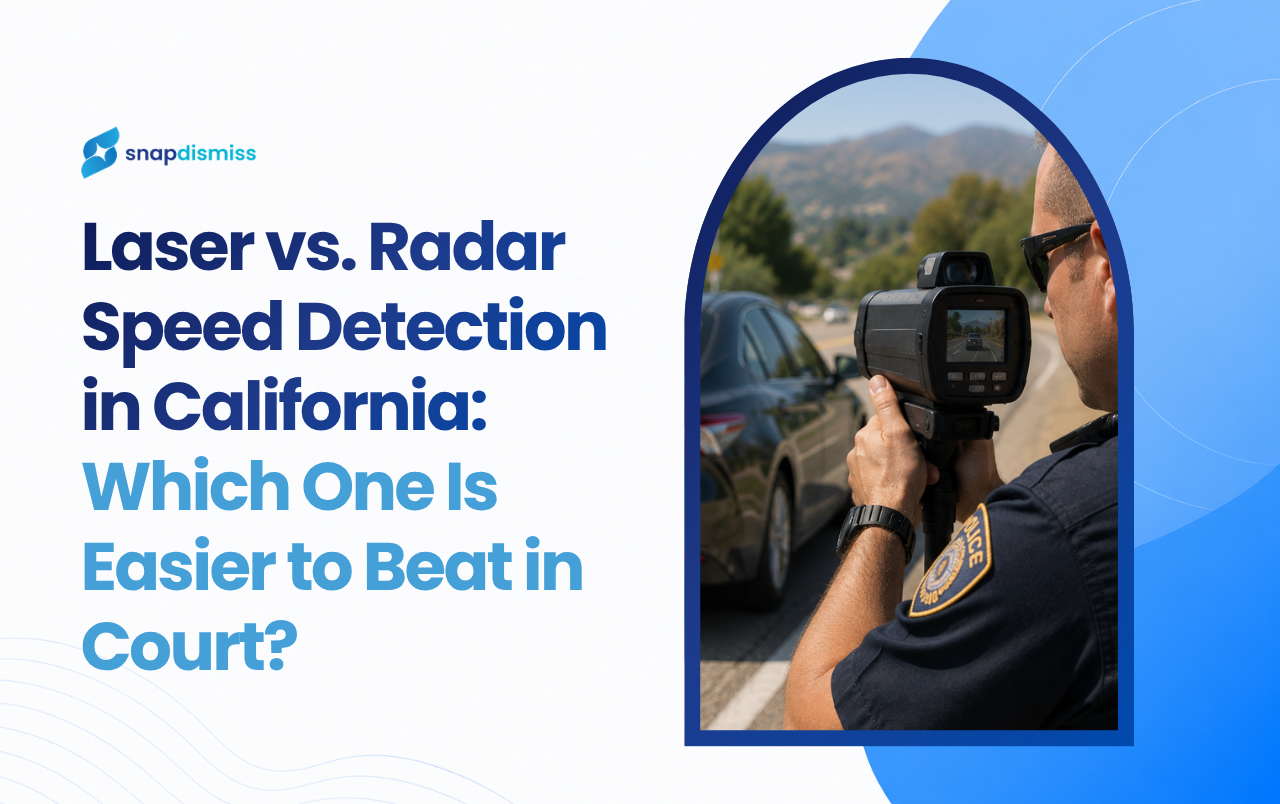
Laser speed detection California officers use commonly called LIDAR fires a narrow, pencil-thin infrared beam at a single point on a vehicle, usually the license plate or headlight. That precision is why misidentifying the wrong car is a much weaker defense against lidar speeding ticket California citations than it is against radar.
But laser has its own weak points:
- Steady-aim requirement the officer must hold the beam on the target vehicle for the full pulse duration (roughly 0.3 to 0.5 seconds). Hand tremor or a moving patrol position can invalidate the reading.
- Longer-distance reflection errors at extended range, the beam can pick up a tree branch, sign, or a different vehicle that briefly crosses the path.
- Weather interference heavy rain, fog, or dust can scatter the infrared beam and produce an inaccurate reading.
- Extra certification requirement under CVC 40802, an officer using laser must complete the same radar training plus an additional POST-certified course of at least two hours. If that additional certification isn’t documented, the reading has a real foundational gap.
Laser vs Radar: Side-by-Side Comparison
| Factor | Radar | Laser (LIDAR) |
|---|---|---|
| Beam width | Wide (cone-shaped) | Narrow (pinpoint) |
| Wrong-vehicle defense strength | Strong, especially in traffic | Weak single vehicle targeted |
| Required officer training | 24-hour POST radar course | Same course plus 2+ hours additional |
| Common failure point | Batching, cosine error, moving-radar math | Unsteady aim, weather scatter, reflection |
| Calibration | Tuning fork, each shift | Internal self-test plus 3-year facility calibration |
| Generally easier to challenge | Yes, in most traffic scenarios | Only with a specific technical defense |
The radar vs lidar speeding ticket comparison ultimately comes down to this: radar gives you more angles of attack, but laser isn’t airtight it just requires a more targeted, technical challenge.
The Legal Requirements Both Devices Must Meet
Under California Vehicle Code 40802, any speed detection device California officers use whether radar or laser is subject to the same core requirements:
- A current engineering and traffic survey for the road, valid for 5 years (or 7 years if the officer is certified and the equipment meets NHTSA standards).
- POST-certified officer training a minimum 24-hour radar course, with laser operators requiring additional hours.
- NHTSA-compliant equipment calibrated within the prior three years by an independent certified facility.
Local residential streets are exempt from the survey requirement, which matters if your citation happened on a neighborhood road rather than a surveyed arterial or highway.
Step-by-Step: How to Challenge a Radar or Laser Reading
- Identify the exact device from your citation radar, laser, or LIDAR are often specified in the detection method field.
- Request the engineering and traffic survey date for the road where you were cited, if you plan to challenge radar speed reading California courts will review, an expired survey is a strong foundation challenge.
- Ask about calibration records tuning fork logs for radar, facility calibration certificates for laser.
- Note traffic conditions at the time of citation for radar, document how many vehicles were nearby to challenge laser speed reading California officers recorded only if a targeting issue is plausible.
- Write your Declaration of Facts around the specific weak point for the device used, referencing the exact Vehicle Code element the prosecution can’t establish.
Real Example: Same Speed, Different Devices, Different Outcomes
| Radar Citation (Heavy Traffic) | Laser Citation (Clear Highway) |
|---|---|
| Declaration challenged wrong-vehicle targeting: “Exhibit A shows four vehicles within the radar’s 18-degree beam width at the time of the reading.” | Declaration challenged aim duration: “Exhibit A shows the officer’s stated distance of 800 feet, at which atmospheric scatter and required steady-aim duration are difficult to maintain without documented calibration confirmation.” |
| Judge found reasonable doubt about which vehicle triggered the reading. Dismissed. | Judge found the citation and equipment records sufficient despite the challenge. Convicted. |
Same declaration-writing discipline, different results because the radar case had a genuinely stronger technical gap to exploit.
Common Mistakes Drivers Make
- Using a radar defense against a laser citation. The wrong-vehicle argument that works well when you fight radar speeding ticket California cases rarely holds up against laser’s narrow beam.
- Ignoring the survey and calibration angle entirely. Most drivers only argue “I wasn’t going that fast,” missing the stronger foundational challenges.
- Assuming laser is unbeatable. Drivers who fight laser speeding ticket California citations often skip the certification and steady-aim angles, which are real, exploitable weak points.
- Not identifying which device was actually used. Citations sometimes list the detection method vaguely; it’s worth confirming before you write your declaration.
Expert Tips
- Match your defense to the device. Wrong-vehicle arguments for radar, aim-and-calibration arguments for laser.
- Photograph the citation location within a day or two to document traffic density (for radar) or sightline distance and obstructions (for laser).
- Always ask about the engineering survey. It’s one of the most overlooked and most effective challenges for either device.
- Don’t concede the speed in your declaration. Focus entirely on what the prosecution can’t prove about the device’s reliability in your specific situation.
Frequently Asked Questions
Is it easier to beat a radar or laser speeding ticket in California?
Radar is generally easier to challenge because its wide beam can misidentify which vehicle triggered the reading, especially in traffic. Laser’s narrow beam targets a single vehicle precisely, making wrong-vehicle defenses weaker, though laser has its own calibration and steady-aim vulnerabilities.
What’s the difference between laser and radar speed detection?
Radar uses a wide radio-wave cone that can reflect off multiple vehicles, while laser (LIDAR) uses a narrow infrared beam aimed at one specific point on a single vehicle. This difference in precision directly affects which legal defenses apply to each.
Do California officers need special training to use laser speed detection?
Yes. Under CVC 40802, officers using laser devices must complete the standard 24-hour POST radar course plus an additional certified course of at least two hours specific to laser operation. Missing documentation of that additional training is a real foundational weakness.
Can I challenge a speeding ticket based on missing calibration records?
Yes. Both radar and laser devices must be calibrated within three years of the citation by an independent certified facility, and radar additionally requires tuning-fork testing each shift. Missing or undocumented calibration is grounds to challenge the reading’s reliability.
Does the road need a current speed survey for radar or laser tickets to be valid?
In most cases, yes. California requires a current engineering and traffic survey (valid 5 to 7 years) for roads with prima facie speed limits enforced by radar or laser. Local residential streets are typically exempt. An expired survey can invalidate the citation.
What’s the best way to fight a speeding ticket without a lawyer?
Identify the specific detection device used, request the survey and calibration records, and write a written declaration under CVC 40902 that targets the exact technical weakness of that device rather than simply denying the speed. This approach applies whether you’re trying to how to fight a speeding ticket in California courts will actually take seriously, without hiring an attorney.
Fighting Your Speeding Ticket, Matched to the Right Device
Winning a laser vs radar speeding ticket California case isn’t about picking a generic defense off a template it’s about matching your challenge to the exact device that cited you. Radar gives you more room to argue misidentification; laser demands a sharper, calibration-and-training-focused approach. Either way, solid speeding ticket defense California strategy starts with knowing which device you’re actually up against.
SnapDismiss identifies your citation’s detection method, builds the right technical challenge for radar or laser, and generates a court-ready TR-205 declaration for a flat $149.
Check your speeding ticket eligibility now →
Want to dig deeper first? See how strong California speeding ticket defense arguments compare across violation types, learn what a solid radar speeding ticket defense looks like in practice, or see the full laser speeding ticket defense checklist before you file.
Disclaimer: This article is for general informational purposes only and does not constitute legal advice. Individual circumstances vary. For advice specific to your case, consult a licensed California attorney. See the full SnapDismiss disclaimer for details.