Stop Sign Ticket in California: The 3 Legal Arguments That Actually Work in 2026
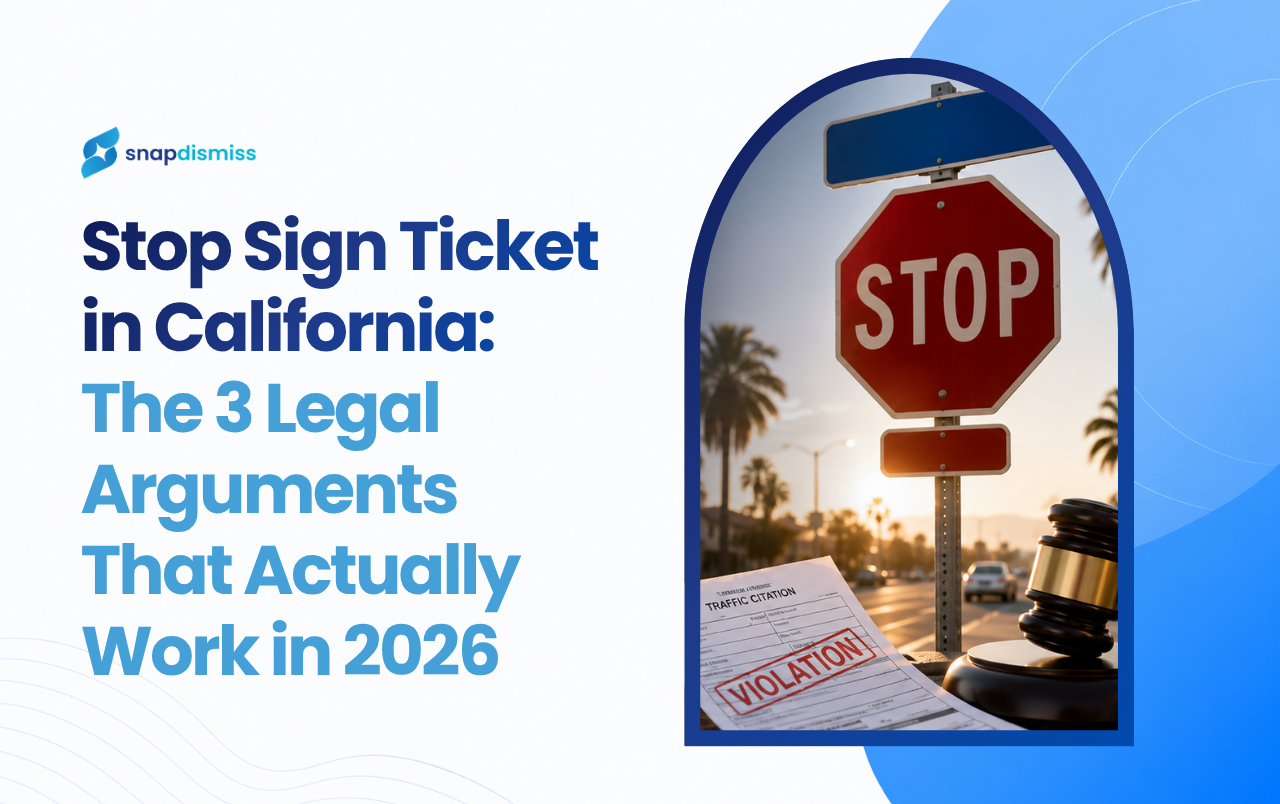
A stop sign ticket California drivers receive under Vehicle Code 22450 usually comes with a minimum fine of $238 plus court fees, and one point on your driving record that can raise your insurance for three years. Most drivers assume there’s nothing to argue I either stopped or I didn’t. That’s wrong. CVC 22450 has specific legal requirements the officer and the sign itself must meet, and three arguments built around those requirements are winning written-declaration cases in 2026.
This guide breaks down exactly what those three arguments are, how to back each one with evidence, and how to put them in writing so a judge actually has to weigh them.
What CVC 22450 Actually Requires
California Vehicle Code 22450 requires drivers to come to a complete stop at a limit line, before a crosswalk, or at the entrance to the intersecting roadway if neither exists. Complete means the vehicle’s forward motion fully stops zero speed, however briefly. A slow roll through the intersection, even at 2 or 3 mph, is a violation regardless of how careful the driver was.
But the statute isn’t just about the driver’s behavior. It also assumes two things are true: that the stop sign itself is a legally compliant traffic control device, and that the officer had a clear, unobstructed view of the stop. When either assumption breaks down, you have a real defense not a technicality, a legitimate gap in what the prosecution can prove.
Why Most Drivers Lose a Stop Sign Ticket California Case
The typical driver who tries to fight a stop sign ticket California court will file just leads with I did stop. That’s a factual assertion pitted directly against the officer’s factual assertion and officers usually win that swearing match because their citation carries presumed credibility as a sworn statement.
The declarations that actually win don’t argue the same fact from the opposite side. They attack a specific legal element the officer has to establish and usually can’t fully support in a one-paragraph citation. That’s the root cause of most losses: drivers argue emotion and memory instead of the three elements below.
The 3 Legal Arguments That Actually Work
1. The Sign Wasn’t a Legally Compliant Traffic Control Device
A California stop sign ticket requires that the sign be visible, properly placed, and unobstructed at the time of the alleged violation. If foliage, a parked truck, graffiti, snow, or fading paint made the sign difficult or impossible to see from a normal approach, that’s a legitimate stop sign violation California defense.
Evidence that supports this argument:
- Dated photos of the sign taken from your approach angle, ideally within 24-48 hours of the citation
- Google Street View screenshots showing a pattern of obstruction over time
- Photos showing tree branches, overgrown landscaping, or a parked vehicle blocking the sign
2. The Officer’s Vantage Point Couldn’t Confirm a Rolling Stop
Most stop sign citations come from an officer parked at a distance, at an angle, or watching multiple lanes at once. Distinguishing a complete stop from a very slow roll requires a clear, close, unobstructed line of sight and many citing positions don’t provide one.
Evidence that supports this argument:
- Dashcam footage showing your vehicle’s wheels and speed at the limit line
- A diagram showing the officer’s parked position relative to the intersection, with approximate distance and angle
- Any obstruction (a passing vehicle, a building corner, a sign) between the officer’s position and the stop line
3. You Stopped at an Ambiguous or Unmarked Limit Line
CVC 22450 requires the stop at the limit line if one exists, at the crosswalk if it doesn’t, or at the entrance to the intersecting roadway if neither exists. In older or poorly maintained intersections, faded limit lines and inconsistent crosswalk markings make it genuinely unclear where the legal stopping point is. Stopping a few feet off a worn-away line isn’t the same violation as blowing through the intersection.
Evidence that supports this argument:
- Photos of the faded, missing, or unclear limit line and crosswalk markings
- A simple diagram showing where you stopped relative to the intersection
- City or county maintenance records, if you can obtain them, showing prior complaints about the markings
How to Put These Arguments in Writing: The TR-205 Route
All three arguments above are strongest when submitted through a trial by written declaration under CVC 40902, rather than argued verbally in a crowded traffic courtroom. In writing, you control the pacing, the evidence order, and the exact legal language, none of which you get in a rushed in-person hearing.
The TR-205 form is the document that starts this process. Here’s how the three arguments map onto it:
- State your Not Guilty plea and the CVC 22450 charge in the opening line of your Declaration of Facts.
- Name each piece of evidence photos, diagrams, dashcam stills as an exhibit and check the matching box in Section 5.
- Walk through the specific element you’re challenging sign visibility, officer vantage point, or limit line ambiguity referencing each exhibit by name.
- Close with a direct request for a not guilty finding and full bail refund.
This same structure works for most infractions, not just stop signs it’s the foundation of any strong California traffic ticket defense filed by mail.
Real Example: How the Vantage Point Argument Plays Out
Consider a driver cited at a four-way intersection where the officer was parked across the street, roughly 150 feet away, facing at an angle. The citation reads: Observed vehicle fail to come to a complete stop. A weak declaration says “I stopped.” A strong one says:
| Weak Declaration | Argument-Based Declaration |
|---|---|
| “I always stop at that sign. The officer is mistaken.” | “Exhibit A, a diagram of the intersection, shows the officer’s stated position was approximately 150 feet from the limit line at an oblique angle. Exhibit B shows a delivery truck parked on the corner nearest the officer’s position at the time of the citation, consistent with the truck route posted for that block.” |
| No mention of distance, angle, or obstruction. | “Under CVC 22450, the prosecution must establish that the vehicle failed to reach zero speed at the limit line. Given the distance and angle described in Exhibit A, and the obstruction shown in Exhibit B, the officer’s vantage point does not support a reliable determination that my vehicle failed to stop.” |
Same incident, same facts on the ground very different legal weight.
Common Mistakes That Sink a Stop Sign Defense
- Arguing intent instead of elements. “I wasn’t trying to run it” doesn’t address what the officer has to prove.
- Skipping photos entirely. A declaration with no visual evidence is far weaker than one with even two or three clear photos.
- Using only one of the three arguments when two apply. If the sign was partially obstructed and the officer’s position was also poor, use both.
- Paying the fine online to be safe. This is treated as a guilty plea and ends your right to contest the citation entirely.
- Missing the deadline. You typically have limited time from the citation date to contest a stop sign ticket California court will accept before the case defaults.
Expert Tips for a Stronger Declaration
- Return to the intersection at the same time of day. Lighting, shadows, and traffic patterns that affected visibility are often time-specific.
- Photograph from the driver’s actual sightline, not from the sidewalk or a random angle it needs to match what you would have seen.
- Reference the exact CVC 22450 language in your declaration rather than paraphrasing it; judges respond to precision.
- Keep your tone factual, not defensive. Declarations that read like a legal memo outperform ones that read like a complaint.
Frequently Asked Questions About Stop Sign Tickets in California
How much is a stop sign ticket in California?
A CVC 22450 violation carries a base fine of $238, though court penalty assessments typically push the total higher depending on the county. It also adds one point to your driving record, which can raise insurance premiums for up to three years.
Can I fight a stop sign ticket in California without a lawyer?
Yes. Under CVC 40902, any driver can request a trial by written declaration for most infractions, including stop sign violations, without hiring an attorney or appearing in court. You submit your defense and evidence in writing and a judge decides based on the paperwork.
What’s the strongest defense for a rolling stop ticket?
The strongest defenses challenge what the officer can actually prove: whether the stop sign was clearly visible, whether the officer’s position allowed an accurate observation, and whether the limit line was clearly marked. Combining two of these with photo or dashcam evidence is stronger than relying on any single argument alone.
Does a stop sign ticket affect my insurance?
Yes. A CVC 22450 conviction adds one point to your DMV record, and most insurers reassess rates after a moving violation. The increase typically applies for three years from the conviction date, which is often far more expensive than the citation itself.
How long do I have to contest a stop sign ticket in California?
You generally have a limited window from the date on your citation to enter a not guilty plea and request a trial by written declaration, though the exact deadline is printed on your citation or courtesy notice. Missing it can result in a default judgment against you.
Can traffic school help with a stop sign ticket?
Traffic school can mask a point from insurance-facing records in some cases, but it still requires you to plead guilty or no contest and pay the fine. It does not contest the citation it just limits one consequence. Fighting the ticket on the merits avoids the conviction altogether.
Fighting Your Stop Sign Ticket California Case, Made Simple
A stop sign ticket California drivers receive doesn’t have to end in a guilty plea. The sign’s visibility, the officer’s vantage point, and the clarity of the limit line are all elements the prosecution has to support and any one of them can be the gap that gets your case dismissed. Whether you want to fight California traffic ticket charges tied to a stop sign or a different infraction entirely, the written declaration process gives you a real, evidence-based shot without ever setting foot in court.
SnapDismiss builds your entire defense packet OCR intake, the right legal arguments for your specific violation, evidence formatting, and a court-ready TR-205 declaration for a flat $149.
Start your stop sign ticket defense now →
Prefer to see how this compares to hiring counsel or handling it entirely yourself first? Read our full breakdown of traffic ticket defense California options, or check how many days you actually have left to respond before your deadline passes.
You can also see the full range of tools available to fight traffic ticket online, or read why thousands of drivers now handle citations with no attorney traffic ticket support instead of hiring one.
Disclaimer: This article is for general informational purposes only and does not constitute legal advice. Individual circumstances vary. For advice specific to your case, consult a licensed California attorney. See the full SnapDismiss disclaimer for details.