How AI Is Writing TR-205 Declarations That Beat Human-Written Ones in California Courts
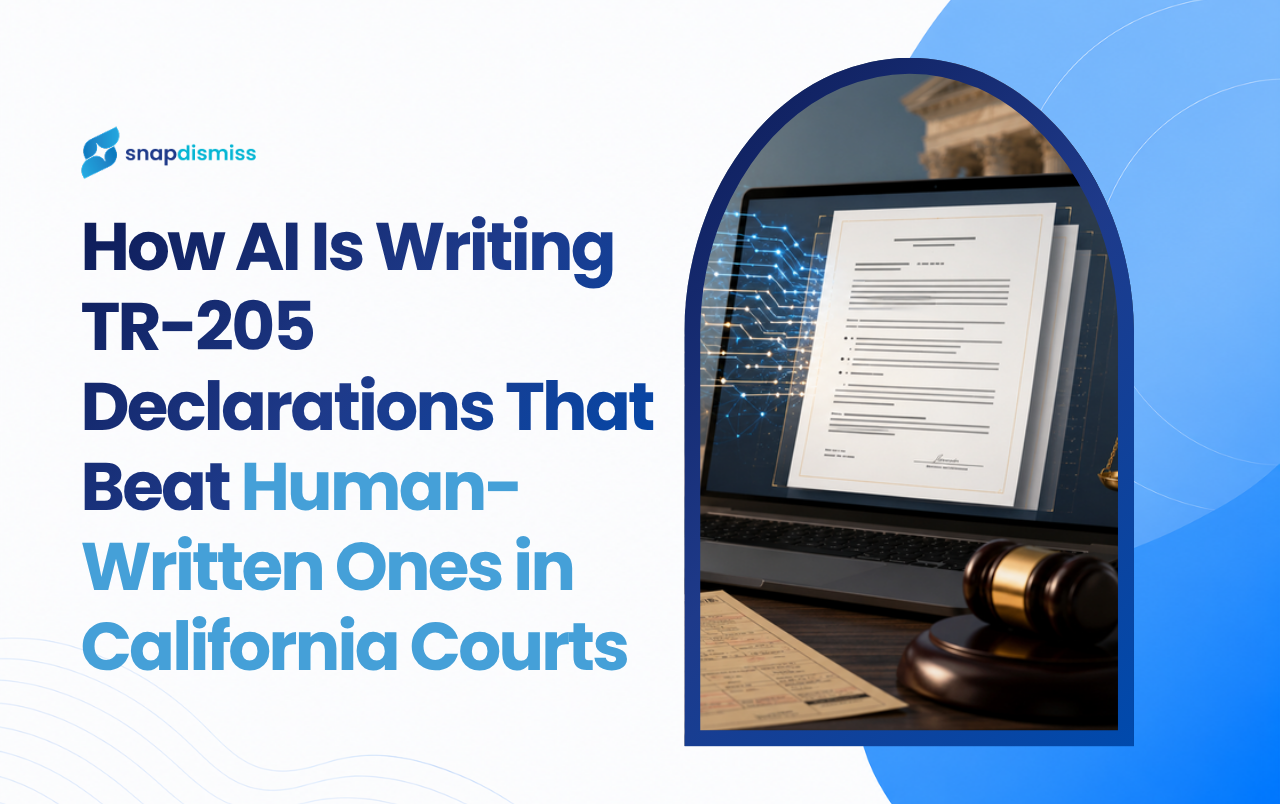
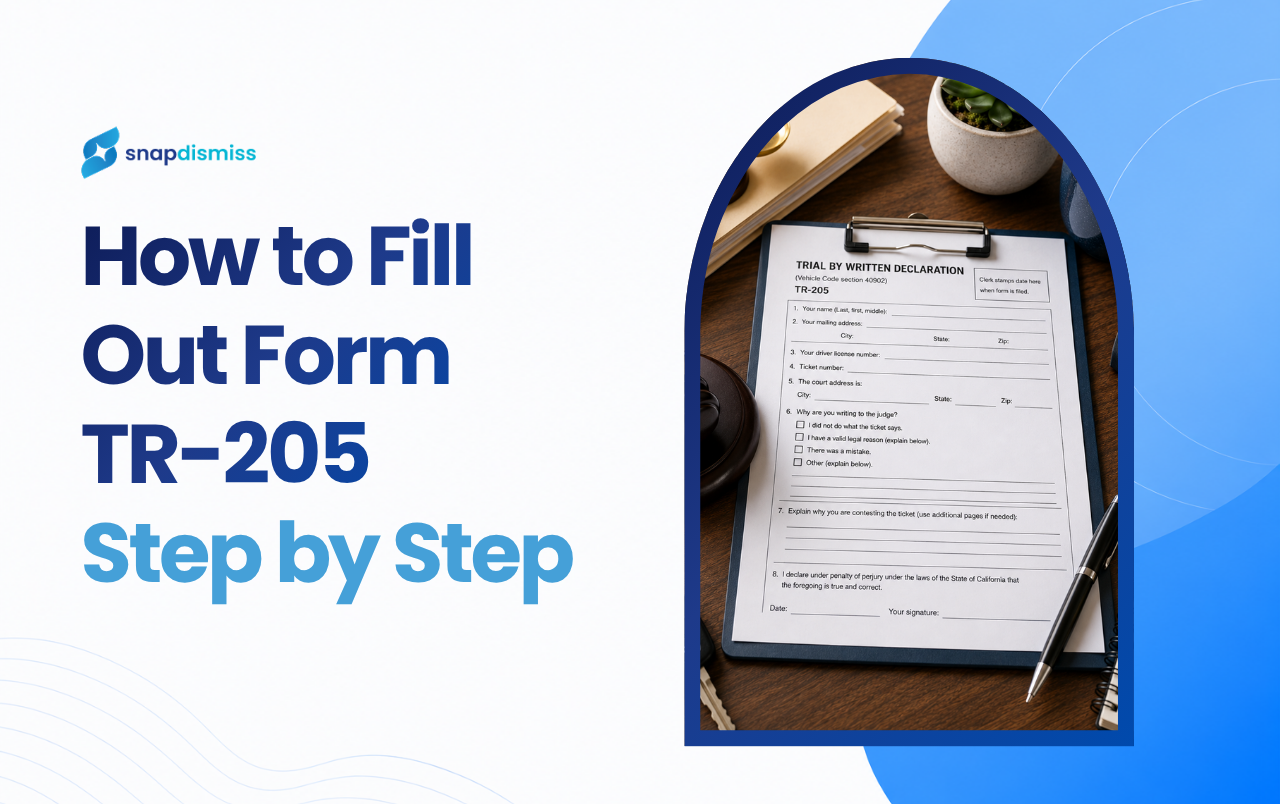
A TR-205 form is the official Judicial Council of California document you file to request a Trial by Written Declaration a way to fight a traffic ticket entirely by mail, with no courtroom and no attorney. Under California Vehicle Code Section 40902, almost any infraction qualifies except DUI-related charges under CVC 23152. The form itself is short. What decides your case is one paragraph on the back: the Declaration of Facts.
In 2026, AI tools are drafting that paragraph, and courts are noticing. Declarations generated with structured, code-referenced AI drafting are being dismissed at higher rates than the average self-written filing and it isn’t because a robot is more persuasive. It’s because AI is more disciplined about the one thing most drivers get wrong: writing a legal argument instead of a story. If your goal is simply to fight a California traffic ticket without the guesswork, understanding why AI declarations are winning is the fastest way to get there.
Why Most Human-Written TR-205 Declarations Lose
A judge reviewing a written declaration under CVC 40902 isn’t grading effort. They’re checking one thing: did the defendant address the specific legal elements the officer must prove for the cited Vehicle Code section? Most people who contest a California traffic ticket on their own don’t know what those elements are, so they write what feels natural instead an apology, an excuse, or a story about their day. None of that moves a judge.
After reviewing thousands of declarations filed through SnapDismiss, three patterns show up again and again in the ones that get rejected or lose:
- Emotional language instead of legal argument. “I wasn’t going that fast” carries no legal weight. “Under CVC 22350, the prosecution must prove my speed was unsafe for conditions, and the following facts show otherwise” does.
- Evidence that’s attached but never explained. A photo with no reference in the declaration is functionally invisible to the judge.
- No challenge to the officer’s detection method. Radar, LIDAR, pacing, and visual estimation all have documented weaknesses that go unmentioned in most self-written filings.
An AI TR-205 form generator doesn’t get tired, doesn’t get emotional, and doesn’t forget to reference an exhibit. That structural consistency is the real advantage and it’s a big part of why AI-assisted filings are outperforming hand-written ones in TR-205 California filings this year.
How AI Actually Builds a TR-205 Declaration, Step by Step
Here’s what happens when you use software to generate TR-205 paperwork instead of writing it from scratch:
- Citation parsing. You photograph or upload your citation. OCR extracts the CVC violation code, court, citation number, and due date automatically.
- Element mapping. The AI identifies exactly what the prosecution must prove for that specific Vehicle Code section the same elements a traffic attorney would look for.
- Guided fact-finding. A short questionnaire captures your version of events in plain language road conditions, signage, timing, and what the officer actually observed.
- Evidence cross-referencing. Every photo, diagram, or document you upload gets matched to the legal point it supports, so nothing you attach goes unmentioned.
- Declaration drafting. The AI writes Section 6 in formal, judge-facing language a factual, code-referenced statement, not a narrative.
- Formatting to spec. The full packet is generated to Judicial Council formatting, the same standard used by attorneys and self-represented filers alike.
This is the core service behind SnapDismiss’s AI TR-205 generator: it turns a blank, intimidating form into a structured legal document in minutes, without requiring you to know the Vehicle Code.
Human-Written vs. AI-Written: A Side-by-Side Example
The difference is easiest to see in the actual language. Both declarations below respond to the same speeding citation under CVC 22350.
| Typical Human-Written Declaration | AI-Generated Declaration |
|---|---|
| “I wasn’t speeding, the officer must have made a mistake. I’ve never gotten a ticket before and I’m a careful driver.” | “I am charged under CVC 22350, which requires the prosecution to prove my speed was unsafe for conditions. Exhibit A shows dry pavement, clear weather, and light traffic at the time and location cited, which the officer’s report does not address.” |
| No mention of the detection method used. | “The citation lists visual estimation as the detection method. Exhibit B, a diagram of the roadway, shows the officer’s fixed position was over 200 feet from the alleged violation point, at an angle that limits reliable visual speed estimation.” |
| Evidence attached with no explanation of relevance. | Every exhibit is named, numbered, and tied to a specific sentence in the declaration, matching Section 5 of the TR-205 exactly. |
Same facts, same evidence very different odds of persuading a judge who reads hundreds of these a month.
Mistakes an AI Generator Can’t Fix for You
AI handles the writing, but a few procedural steps are still on you. These are the mistakes that sink an otherwise strong declaration when someone tries to fight ticket by mail:
- Paying online instead of mailing bail. Most court payment portals process your payment as a fine which is a guilty plea, not a bail deposit for trial.
- Missing the signature line. An unsigned declaration is procedurally defective, no matter how well-written the content is.
- Mailing to the wrong address. Many California courts use a mailing address that differs from their street address.
- Submitting after the deadline. Your packet must arrive by the due date, not just be postmarked by it.
A good AI TR-205 generator will flag these steps for you, but you still have to print, sign, and mail the packet yourself.
Expert Tips for Getting the Most Out of an AI TR-205 Generator
- Upload evidence before you answer the questionnaire. The AI writes stronger, more specific language when it can reference your exhibits directly instead of guessing at what you have.
- Be precise about location and timing. “Near the intersection” is weak. “Eastbound on Main Street, 40 feet before the Oak Avenue signal” gives the AI (and the judge) something concrete to work with.
- Photograph the scene within 24 to 48 hours of the citation. Conditions change, and courts weigh contemporary evidence more heavily than descriptions written weeks later.
- Read the draft before you sign it. You are certifying every fact under penalty of perjury. Everything the AI writes has to be true and something only you can confirm.
These same fundamentals apply whether you use software or traffic ticket defense California methods more broadly the quality of your facts and evidence still sets the ceiling on what any declaration, human or AI-drafted, can achieve.
Frequently Asked Questions About AI and the TR-205 Form
Can AI legally write my TR-205 declaration?
Yes. There is no rule against using software to draft your Declaration of Facts. What matters legally is that you personally review, sign, and swear to the accuracy of everything submitted under penalty of perjury. The AI drafts the language; you remain the declarant.
Does an AI-written TR-205 guarantee a dismissal?
No filing method guarantees dismissal. A judge still decides based on the facts, evidence, and the officer’s response, if one is submitted. What AI improves is the quality and legal structure of your argument, which meaningfully raises your odds compared to a vague, unstructured declaration.
What’s the difference between an AI TR-205 generator and a blank template?
A template gives you blank boxes. An AI generator identifies the legal elements tied to your specific Vehicle Code violation, drafts language that addresses them, and cross-references your uploaded evidence automatically something a static template can’t do.
How long does it take to prepare a TR-205 with AI?
Most AI-assisted TR-205 packets are generated in a few minutes once you’ve uploaded your citation and answered a short set of questions. Compare that to the hours it typically takes to research the Vehicle Code and draft a declaration from scratch.
Is an AI-written declaration accepted by California courts?
Yes, as long as the final document meets the Judicial Council’s formatting requirements and is signed by you under penalty of perjury. Courts don’t evaluate who or what drafted the language; they evaluate whether the completed TR-205 and Declaration of Facts are properly formatted, signed, and submitted with bail.
What happens if the judge rules against me?
Under CVC 40902, you’re entitled to a trial de novo a completely new trial, in person this time, no strings attached. Losing a written declaration doesn’t cost you your right to a traditional hearing.
The Bottom Line on AI and the TR-205 Form
The TR-205 form was never complicated to fill out. It’s complicated to write well. AI is closing that gap by turning the Declaration of Facts into what it was always supposed to be: a focused legal argument, not a personal story. If you’re trying to fight traffic ticket online without hiring a lawyer, that structural discipline is exactly what tips the odds in your favor.
SnapDismiss builds your entire TR-205 packet OCR intake, evidence matching, AI-drafted declaration, and Judicial Council formatting for a flat $149, no attorney required. It’s the same process described above, done for you in minutes.
Start your AI-drafted TR-205 declaration now →
Thousands of California drivers have already used this approach to no attorney traffic ticket defense instead of paying a citation outright or hiring counsel for an infraction. If you’d rather see how the two approaches actually compare in court, read our breakdown of written declaration California outcomes versus in-person hearings.
Disclaimer: This article is for general informational purposes only and does not constitute legal advice. Individual circumstances vary. For advice specific to your case, consult a licensed California attorney. See the full SnapDismiss disclaimer for details.