Can You Request a New Trial After Losing a Written Declaration in California?
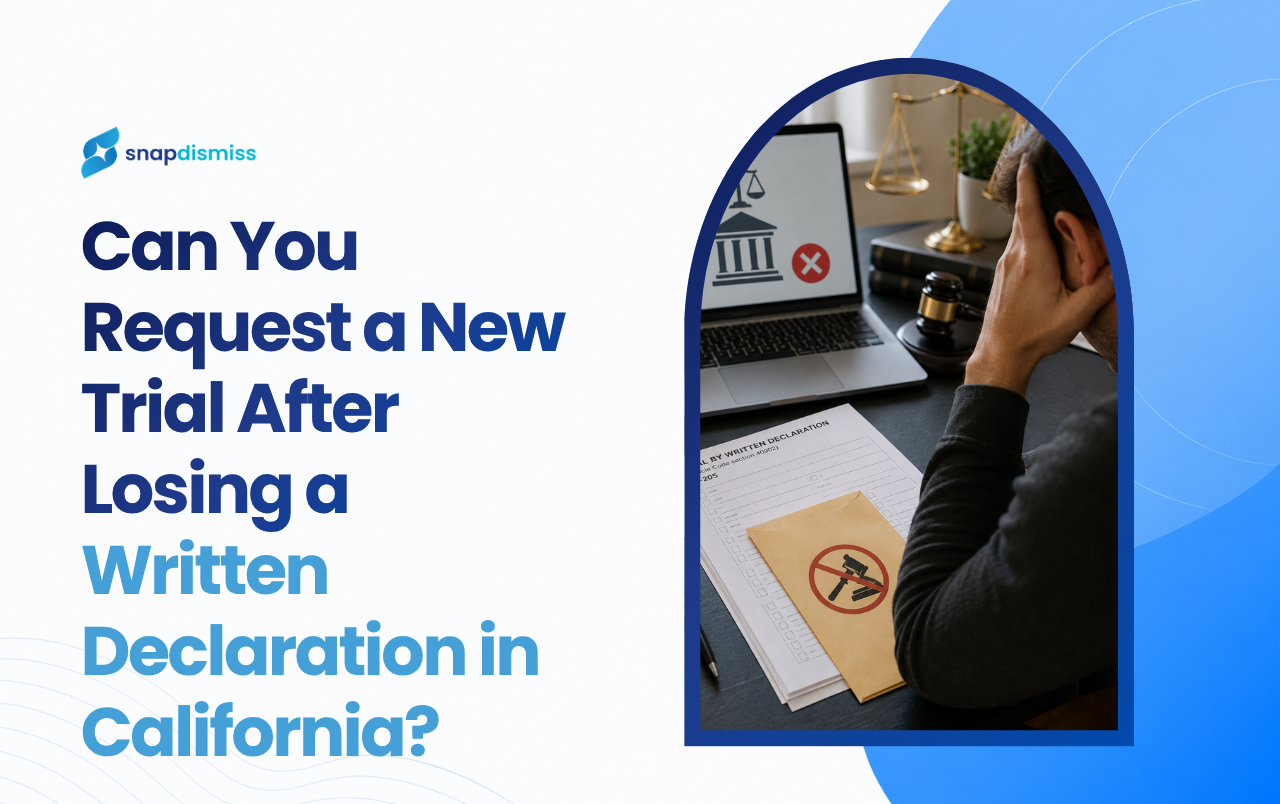
If you just lost a trial by written declaration in California, you are not out of options. State law gives you one more shot at a not-guilty finding: a trial de novo California courts must grant if you ask for one on time, using Form TR-220 (also labeled TRL-220 on newer court forms). It is a brand-new trial, not an appeal, and it is the single most overlooked right in the entire traffic ticket process.
This guide walks through exactly what a trial de novo is, how the 20-day clock works, what changes the second time around, and the mistakes that sink drivers who finally get their second chance.
What Is a Trial de Novo in California?
A trial de novo is a completely new, in-person trial ordered after you lose a trial by written declaration California courts decided by mail. Under California Vehicle Code Section 40902 and California Rules of Court Rule 4.210, the judge disregards the earlier written decision entirely and hears your case fresh, with live testimony from you and, if they choose to appear, the citing officer.
Can You Request a New Trial After Losing a Written Declaration?
Yes. California law entitles every driver who loses a trial by written declaration to request a new trial after written declaration proceedings conclude, no explanation or legal justification required. You do not need to prove the first decision was wrong; simply filing the correct form within the deadline is enough to trigger a full courtroom trial.
What Happens When You Lose a Trial by Written Declaration
After the judge reviews your TR-205 form California traffic courts use for written declarations, the clerk mails a Notice of Decision. If the finding is guilty, that notice states the fine owed and starts the clock on your right to a new trial. Nothing about a guilty finding here is final. It is simply the trigger for your next move.
How the Court Notifies You
The notice arrives by regular mail, usually 60 to 120 days after you filed your declaration. There is no phone call, email, or text alert, which is exactly why so many drivers miss the deadline below without realizing time is already running.
Your Options After a Guilty Verdict
- Pay the fine and accept the point/conviction on your record
- Request a trial de novo and get a fresh in-person hearing
- Do nothing, which locks in the conviction once the deadline passes
How Long Do You Have to Request a Trial de Novo?
You have 20 calendar days from the date the clerk mails the Notice of Decision to file Form TR-220. This is a hard statutory deadline under Rule 4.210, and courts do not extend it for weekends, holidays, or mail delays on your end.
| Milestone | Timeframe |
|---|---|
| Clerk mails Notice of Decision | Day 0 |
| Deadline to file Form TR-220 | Within 20 calendar days |
| Court schedules new trial date | Typically within 45 days of your request |
| In-person trial de novo held | On the scheduled court date |
For a full breakdown of how this window is calculated and why courts enforce it strictly, see our detailed walkthrough of the lost trial by written declaration California deadline.
How Do I Request a Trial de Novo in California? (Step by Step)
Step 1: Get and Complete Form TR-220
Download Form TR-220 (now transitioning to TRL-220 on some court websites, with no change to the underlying rules) from your county traffic court or the California Courts self-help center. Fill in your case number, citation number, and the date the Notice of Decision was mailed.
Step 2: File Before the 20-Day Deadline
Submit the form to the same court that handled your written declaration, either by mail, in person, or online where the county offers e-filing. Keep a dated copy or confirmation as proof of timely filing.
Step 3: Wait for Your Court Date
Once processed, the court mails a new hearing date, generally within 45 days. This is now a standard courtroom session, not a paperwork review.
Step 4: Prepare to Appear In Person
Bring your evidence, witnesses, and a copy of your original declaration. If the citing officer does not show up, many judges dismiss the citation outright, since the prosecution generally cannot proceed without testimony to support the ticket.
Trial de Novo vs. Appeal: What’s the Difference?
Drivers often confuse a California written declaration appeal with a trial de novo, but they are not the same remedy. An appeal asks a higher court to review the first court for legal errors. A trial de novo throws out the first decision entirely and starts over.
| Trial de Novo | Traditional Appeal |
|---|---|
| Brand-new trial, same trial court | Review of the record by a higher court |
| Fresh evidence and live testimony allowed | Limited to arguing legal errors |
| Filed with Form TR-220 within 20 days | Filed under separate appellate procedures |
| Standard remedy after a written declaration loss | Rare in routine infraction cases |
Real-World Example
Consider a driver cited for speeding who submitted a written declaration arguing the radar unit was uncertified. The court found her guilty because her declaration didn’t include the specific certification date. Rather than paying the fine, she filed Form TR-220 within the 20-day window, appeared at the new trial, and cross-examined the officer directly about the device’s calibration records, since he did not have them on hand, the judge dismissed the citation. This is a common pattern: the second trial rewards drivers who use the live courtroom setting to expose gaps that never surfaced in the paper record.
Common Mistakes That Cost Drivers Their Trial de Novo
- Miscounting the 20-day window by using the decision date on the notice instead of the mailing date
- Assuming the request is automatic and skipping Form TR-220 entirely
- Not keeping proof of when the form was filed, which matters if the court disputes timeliness
- Treating the new trial like round two of the written declaration instead of preparing to speak and answer questions live
- Failing to request the officer’s presence or subpoena records that could support a dismissal
Expert Tips to Win Your Trial de Novo
- File the same day you receive the Notice of Decision, don’t wait until day 19
- Request a copy of the officer’s notes or citation record before your hearing date
- Organize your original TR-205 declaration and any exhibits into a single, easy-to-reference packet
- Practice stating your defense in two or three sentences, judges move quickly through traffic calendars
- Show up prepared to question the officer directly if they appear, since inconsistencies often surface only under live questioning
Frequently Asked Questions
Can you request a new trial after a written declaration?
Yes. Any driver who loses a trial by written declaration in California can request a new trial (trial de novo) by filing Form TR-220 within 20 calendar days of the clerk’s mailed decision. No special grounds are required.
What happens if you lose a trial by written declaration in California?
The court mails a Notice of Decision showing the guilty finding and fine owed. You can pay the fine and accept the conviction, or file for a trial de novo within 20 days to get a fresh, in-person hearing before the fine becomes final.
How do I request a trial de novo in California?
Complete Form TR-220 with your citation and case number, file it with the same court that handled your written declaration, and wait for a new hearing date, typically scheduled within 45 days.
How long do you have to request a trial de novo?
You have 20 calendar days from the date the court clerk mails the Notice of Decision. This deadline is strict, and missing it locks in the original guilty finding.
Does a trial de novo cost anything?
Filing Form TR-220 itself does not carry a separate court fee in most California counties, though you remain responsible for the underlying fine if you are found guilty again at the new trial.
Will the officer who wrote my ticket show up to the trial de novo?
The officer is not guaranteed to appear. If they don’t, many courts dismiss the case because the prosecution typically needs the officer’s testimony to prove the violation without it.
Fight Smarter the Second Time Around
Losing a written declaration is not the end of your case, it’s a checkpoint. Filing for a trial de novo California law entitles you to, on time and prepared, is often where drivers actually turn their case around, because live testimony exposes weaknesses a paper record can hide. Whether you’re just learning how to fight California traffic ticket charges from scratch, or you’re already past your first written declaration and weighing whether to contest California traffic ticket findings a second time, Snapdismiss helps you build a stronger declaration and defense strategy from day one, so you’re less likely to need a trial de novo at all. And if you’re comparing your options before you even file, our guide to traffic ticket defense California drivers rely on most breaks down every path side by side.
Ready to put together a stronger case? Snapdismiss uses AI to help you draft a sharper declaration and prepare for whatever comes next, written trial or trial de novo, without hiring a lawyer or missing a single deadline.