No Courtroom Needed: How to Beat a California Traffic Ticket From Home
It’s 9 PM on a Tuesday. You got a traffic ticket this morning, the citation is sitting on your kitchen counter, and your mind is already running the worst-case math: court dates, missing work, attorney fees, insurance increases.
Here is what you don’t know yet: you can fight a traffic ticket in California from your kitchen table. Right now. In your pajamas. Without missing a single hour of work, without setting foot in a courthouse, and without hiring a lawyer.
California law specifically authorizes this. California Vehicle Code Section 40902 gives every driver charged with a traffic infraction the right to contest that citation entirely in writing. The court reviews both sides and mails you a decision. This guide shows you exactly how from the moment you receive your ticket to the moment it’s dismissed.
Why Just Pay the Fine Is the Most Expensive Decision You’ll Make This Year
Every California driver who pays their traffic ticket without contesting it makes a $3,800–$4,200 mistake most of them just don’t realize it until the insurance renewal notice arrives.
Here’s the breakdown most drivers never see:
- The printed fine is a fraction of the actual cost. A base fine of $35 becomes $230+ after mandatory state and county penalty assessments.
- Payment = guilty plea. Under California Vehicle Code Section 40903, paying your ticket is a legal conviction not just a fee. The DMV records the point. Your insurer gets notified.
- Insurance increases by 35–40% after a single moving conviction and stays elevated for three to five years. On the average California full-coverage premium of $2,559/year, that’s over $900 extra annually for five years.
- DMV points accumulate. Enough points trigger the Negligent Operator Treatment System license suspension, mandatory hearings, and a paper trail that follows you for years.
A successful dismissal eliminates every one of those costs. No fine. No point. No insurance increase. And the process to achieve it? You can handle it entirely from home.
The Home-Based Defense Method: Trial by Written Declaration Explained
The official name is a Trial by Written Declaration (TR-205). The practical reality is that it is a fully legal, judge-reviewed court process conducted entirely through the mail (or online in select courts) that gives you a genuine shot at full ticket dismissal without leaving your home.
A Trial by Written Declaration is a court-authorized process under California Vehicle Code §40902 where you submit a sworn written defense to the court, the officer may submit their own statement, and a judge mails you the decision typically within 30 to 90 days. No courtroom. No appearance. No lost workday.
It is available to any California driver charged with an infraction-level traffic violation speeding, red light, stop sign, cell phone use, unsafe lane change, and most standard moving violations provided the citation does not carry a “Must Appear” notation.
And here is the detail that changes everything for most drivers: if you lose the written declaration, you are entitled to a completely fresh in-person trial (called a Trial de Novo) under CVC Section 40902(d). This is not an appeal it is a brand-new trial before a different judge with new evidence allowed. Traffic court is the only court in California where you can legally fight the same case twice. You truly have nothing to lose by trying the written route first.
Your Complete Home-Based Playbook: Fight a Traffic Ticket in California Step by Step
Day 1: The Moment You Get Home (Don’t Wait)
The most valuable defense work happens in the first 24 hours. Memory is fresh. Evidence is undisturbed. Roads look exactly as they did when you were cited.
- Read your citation completely. Extract: the specific Vehicle Code (CVC) section, the court name and address, your due date, the detection method used (radar, LIDAR, pacing, camera, or visual), and any “Must Appear” notation.
- Write down every detail you remember exact time, road conditions, weather, traffic density, visibility, the officer’s position, what they said, and what you observed about signage. These become your Declaration of Facts.
- Return to the scene and photograph it. Take dated, geotagged photos of: speed limit signs and their visibility from your approach, road markings, sight lines, any obstructions (vegetation, curves, parked vehicles). These are your exhibits. Conditions change get them now.
- Look up your specific CVC section. Visit leginfo.legislature.ca.gov and read the exact text of the law you’re accused of violating. Identify each element the prosecution must prove. Your defense is built around what they can’t establish not what you want to explain.
Day 2–3: Plead Not Guilty and Request Your Written Declaration
- Contact your court by mail, in person, or via their online portal and formally plead Not Guilty.
- Request a Trial by Written Declaration under California Vehicle Code §40902.
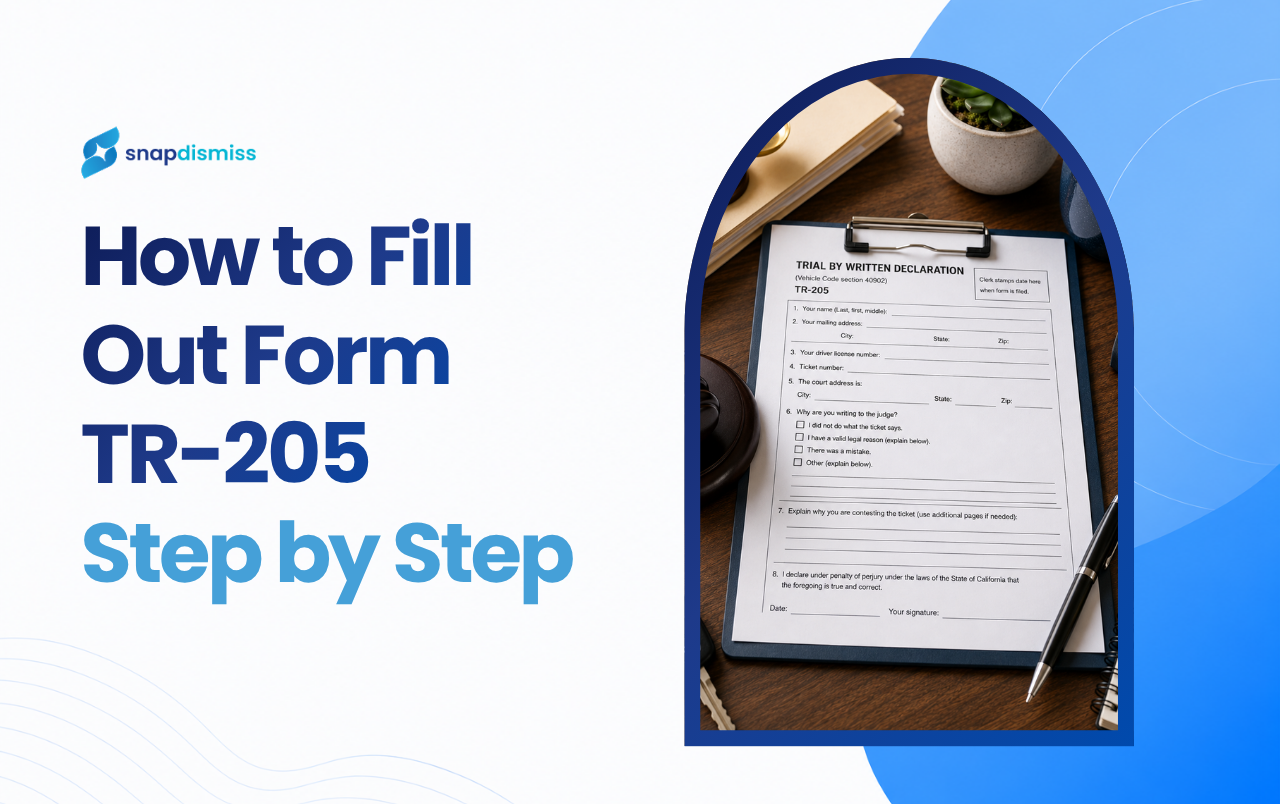
- Request Form TR-200 (Instructions to Defendant) and Form TR-205 (your filing form).
- Simultaneously submit a discovery request in writing ask for the citing officer’s notes, the speed detection device’s calibration and maintenance records, and any available bodycam or dashcam footage. Courts must provide this under California discovery rules, and gaps in these records are some of the most powerful defense tools available.
Pro tip use time as your ally: You can request a 30–60 day extension from the court before your due date. Many courts grant this without question. The delay works in your favor: by the time a Trial de Novo is eventually scheduled if needed the officer may be reassigned, on leave, or simply unable to recall the specifics of a routine stop from months earlier. Memory fades. Evidence doesn’t.
Week 1: Build Your Declaration of Facts
This is the most important document you will write. The Declaration of Facts (Section 6 of Form TR-205, or a continuation on Form MC-031) is what the judge reads to determine your case. It must be a legal argument, not a personal narrative.
Structure your declaration using this framework:
- Opening statement: “I, [Full Name], declare under penalty of perjury that: Citation No. [XXXX], I plead Not Guilty to a violation of CVC [section].”
- Context of the stop: Precise road, lane, direction, time, weather, visibility, and traffic conditions. Be specific not “it was daytime” but “visibility was approximately 800 feet in clear weather with no precipitation.”
- Detection method challenge: What method did the officer use? For radar reference calibration requirements. For LIDAR reference proper operational protocols. For pacing challenge the consistency of following distance and speedometer verification. For cameras address notice timing under CVC 40518 and certification requirements.
- Code-specific legal argument: Name the CVC section and identify the element the prosecution cannot establish. For CVC 22350 (Basic Speed Law): “The prosecution cannot establish that my speed was unsafe for existing road and traffic conditions, as [road was dry / traffic was light / visibility was clear / no hazards were present].” This is not a story it is a legal argument targeting a specific element.
- Evidence references: “Exhibit A is a photograph taken [date] at [location] demonstrating that the posted speed limit sign is not visible from the eastbound approach lane due to a tree branch.” Label every piece of evidence in the declaration before it appears in your package.
- Closing: “For the foregoing reasons, I respectfully request the court find me Not Guilty and refund all bail deposited.”
If you want this done precisely, legally, and targeted to your specific violation code without hours of research, SnapDismiss’s AI-powered TR-205 generator produces a complete, court-ready declaration in under 10 minutes from your citation details.
Submission Day Assemble and Mail Your Package
Your complete submission package contains:
- Completed, signed Form TR-205 (all fields filled, “Court Use Only” sections left blank)
- Declaration of Facts on Form MC-031 if you need more space
- All labeled evidence exhibits (Exhibit A, B, C…)
- Bail payment by check or money order made payable to “Superior Court,” with citation number and “Not Guilty” written in the memo line never through the online fine portal
- A self-addressed stamped envelope (some courts require or prefer this)
Mail via USPS Certified Mail with Return Receipt to the court’s mailing address always verify this is different from the street address. Keep the tracking number and receipt permanently. Make complete copies of your entire package before sealing the envelope.
Submit 5–7 days before your due date not weeks early, not the day before.
Decision Day Act on the Outcome Immediately
The court mails a Notice of Decision (Form TR-215) within 90 calendar days. Two outcomes, both manageable:
- Not Guilty / Dismissed: Bail refunded. No DMV point. No insurance increase. Ticket erased. Done.
- Guilty: File Form TR-220 (Request for Trial de Novo) within 20 calendar days of the TR-215 mailing date. This opens a brand-new in-person trial before a different judge new evidence allowed, officer must appear in person (if they don’t, case dismissed), and your written declaration is treated as if it never happened. Set a calendar reminder the moment you open any guilty verdict.
Defenses That Win From Home: Targeting What Prosecutors Can’t Prove
The most effective home-based defenses aren’t clever tricks they are precise legal arguments that identify a gap in the prosecution’s evidence. Here are the strongest ones by violation type:
| Violation | CVC Section | Strongest Home Defense Angle |
|---|---|---|
| Speeding Basic Speed | 22350 | Speed was not unsafe for actual conditions target weather, traffic, visibility, road surface. Not the number. |
| Speeding Absolute Limit | 22349(a) | Radar/LIDAR calibration gap; officer vantage point obstruction; speedometer verification absence. |
| Red Light (officer) | 21453(a) | Officer’s sight line from observation point; signal timing evidence; vehicle position in intersection. |
| Red Light (camera) | 21453(a) | Notice served after 15-day CVC 40518 deadline; camera calibration certification; registered owner ≠ driver. |
| Stop Sign | 22450(a) | Officer’s angle and distance from stop bar; sign visibility and proper posting compliance. |
| Cell Phone | 23123 / 23123.5 | Device was not in hand; officer’s observation distance and angle; vehicle was stationary. |
How SnapDismiss Brings the Entire Process to Your Home
SnapDismiss was built for exactly this situation. You have a ticket. You want to fight it. You don’t have hours to spend researching Vehicle Code sections and drafting legal arguments from scratch. Here is what happens when you use SnapDismiss:
- Enter your citation details: violation code, detection method, date, location, and court. Takes under 2 minutes.
- Instant eligibility check: the platform confirms whether your ticket qualifies for Trial by Written Declaration.
- AI analyzes your specific CVC section: identifies every legal element required for conviction and maps where the prosecution’s evidence is most likely to fall short.
- Complete court-ready declaration generated: violation-targeted arguments, properly formatted, with evidence references built in. This is not a generic template it targets your specific violation code.
- You review, sign, and mail: print the package, attach your bail and evidence, and send certified mail. Or use your court’s online MyCitations portal if available in your county.
- Deadline tracking and Trial de Novo guidance: SnapDismiss tracks your court due date and walks you through your second chance if the written declaration doesn’t produce a dismissal.
Total active time: under 15 minutes. The entire rest of the process the waiting, the judge reviewing, the officer responding or not happens without you doing anything further.
8 Mistakes That Derail a Perfectly Good Home Defense
- Paying the fine online before reading all your options. The court’s online portal in most counties processes payment as a guilty plea not as bail. Once paid, the case closes as a conviction with no path back.
- Writing a story instead of a legal argument. The judge rules on whether the prosecution can prove each element of the violation. Your declaration must target those elements not explain why you were in a hurry or how careful a driver you are.
- Not returning to the scene immediately. Speed limit signs get replaced. Foliage gets trimmed. Construction zones get cleared. Physical evidence degrades fast. Photograph the scene within 48 hours of the citation.
- Using the street address instead of the mailing address. Many California Superior Courts have separate mailing addresses. Using the wrong address can cause your package to sit unprocessed and the deadline doesn’t stop for postal errors.
- Not signing both TR-205 and every continuation page. An unsigned declaration is procedurally defective. Courts can reject it entirely or treat it as unfiled.
- Attaching evidence without labeling or explaining it. A photo attached to your package without being named “Exhibit A” in your declaration and explained explicitly carries zero evidentiary weight. The judge won’t guess why it’s relevant.
- Missing the 20-day Trial de Novo window. If found guilty, you have exactly 20 calendar days from the mailing date on Form TR-215 to file TR-220. This right is absolute and forfeited forever if you miss it.
- Waiting until the week before the due date. Discovery requests, extension requests, photo-taking, and declaration writing all require time. Start within 48 hours of receiving your ticket.
Expert Tips From the Field
- Ask for an extension first it costs nothing and buys everything. Contact the court before your due date and request a 30–60 day extension. Most courts grant this routinely. The extra time lets you build a stronger case and increases the likelihood the officer’s memory of your specific stop has faded by the time of any Trial de Novo.
- Request discovery the same day you plead not guilty. Calibration logs and officer notes are legally discoverable. Gaps in calibration records, missing maintenance entries, or expired device certifications can make a strong declaration even stronger and sometimes make the prosecution’s case impossible to sustain.
- Type your declaration never handwrite it. A typed declaration on MC-031 continuation pages reads as professional and credible. A handwritten one, however accurate, creates an impression of informality that can undercut your case before the judge reads the first sentence.
- Think like a prosecutor, not a defendant. Ask yourself: what does the prosecution need to prove to convict me? Then ask: what evidence do they actually have? Every gap between those two questions is an argument in your declaration.
- Use SnapDismiss for the declaration then personalize it. An AI-generated TR-205 declaration gives you a legally precise framework targeting your specific CVC section. Review every statement for accuracy against the actual facts of your stop. The generator builds the legal scaffold you add the specific factual details that only you know.
Frequently Asked Questions: Fight a Traffic Ticket in California From Home
Can I really fight a traffic ticket in California without going to court?
Yes. California Vehicle Code Section 40902 gives every driver charged with an eligible traffic infraction the right to contest their citation through a Trial by Written Declaration entirely in writing, by mail, with no court appearance required. The process is available in all 58 California counties and has been a legal right since 1999. Certain courts also offer a fully digital online version through the MyCitations portal.
How long does fighting a ticket from home actually take?
Your active time researching, writing, and submitting your declaration is 2 to 10 hours if done manually, or under 15 minutes using an AI platform like SnapDismiss. After submission, the court process takes 30 to 90 days for a decision. If you request a Trial de Novo, add another one to three months. Total timeline from citation to final resolution: typically four to six months, with nearly all of it requiring no active effort from you.
What is the biggest factor in whether my written declaration wins?
Two factors dominate outcomes: whether the officer responds at all, and the quality of your Declaration of Facts. Approximately 25–30% of California TR-205 cases are dismissed because officers fail to respond by the court’s deadline. Among cases where officers do respond, the quality of your declaration specifically whether it targets the legal elements of your exact violation code with factual precision is the primary driver of the judge’s decision.
What happens if I lose my Trial by Written Declaration?
A guilty verdict is not final. Under CVC Section 40902(d), you have exactly 20 calendar days from the mailing date of your Notice of Decision (Form TR-215) to file Form TR-220 requesting a Trial de Novo. This is a completely fresh in-person trial before a different judge. Your written declaration is treated as if it never occurred. You can present new evidence, new witnesses, and cross-examine the citing officer directly. If the officer doesn’t appear in person, the case is dismissed immediately.
Does fighting a traffic ticket affect my eligibility for traffic school?
Not automatically but you must protect that right proactively. Many California courts require you to request traffic school eligibility within your written declaration submission. If your TR-205 results in a guilty verdict and you didn’t note your traffic school request in the original filing, the court may deny the option. Always include a traffic school request as a fallback within your TR-205, even if your primary goal is full dismissal.
What types of tickets can I fight from home in California?
Most standard moving violation infractions are eligible: speeding (CVC 22349, 22350, 22356), red light (CVC 21453), stop sign (CVC 22450), cell phone use (CVC 23123, 23123.5), unsafe lane change (CVC 21658), and most other traffic infractions. Tickets marked “Must Appear,” misdemeanor violations, citations involving accidents, and speeding over 100 mph under the FAST program require in-person court appearances and are not eligible for written declaration.
How does SnapDismiss help me fight my ticket from home?
SnapDismiss is an AI-powered California traffic defense platform that handles the hardest part of the home defense process writing a legally targeted Declaration of Facts. You enter your citation details, the platform analyzes your specific Vehicle Code section and detection method, and generates a complete court-ready TR-205 package in minutes. It also tracks your deadlines and guides you through the Trial de Novo process if your written declaration doesn’t succeed. No attorney required.
Fight a Traffic Ticket in California From Home Your Window Is Open Right Now
The courthouse was never required. The lawyer was never required. The lost workday, the parking, the waiting room none of it is mandatory for California drivers who know how the system actually works.
What is mandatory is acting before your due date. That deadline is the only thing standing between you and a full, legitimate shot at dismissal from your own home. Miss it and the options narrow dramatically. Meet it and you have a real process, a real judge, and a real chance without leaving your couch.
Start with SnapDismiss right now. Check your eligibility in under 2 minutes. Get your court-ready declaration generated in under 15. Mail it before your deadline and let the process work for you.
Disclaimer: This article is for general informational purposes only and does not constitute legal advice. SnapDismiss is not a law firm and does not provide legal representation. For advice specific to your situation, consult a licensed California attorney. See the full SnapDismiss disclaimer.