No Attorney Required: How Thousands of Californians Dismiss Their Tickets Themselves

The traffic ticket is sitting on your counter. The fine is eye-watering. The insurance math is worse. And somewhere in the back of your mind is a voice saying: “I probably need a lawyer for this, right?”
Wrong. And that assumption is costing California drivers billions of dollars every year.
There is no legal requirement to hire an attorney to fight a traffic ticket in California. California’s court system was specifically designed to allow self-represented drivers to contest traffic infractions and thousands do it successfully every single year with no attorney required. All it takes is knowing the right process, the right form, and the right arguments. This guide gives you all three.
Ready to start now? SnapDismiss gets you court-ready in under 10 minutes.
No Attorney Traffic Ticket Defense: What California Law Actually Says
Under California Vehicle Code Section 40902 and California Rules of Court Rule 4.210, any driver charged with a traffic infraction has the explicit legal right to contest that citation in writing with no court appearance and no attorney involvement whatsoever. The California DMV Handbook itself states: “Representation by an attorney is not required.”
This isn’t a loophole. It isn’t a technicality. It is a court-sanctioned process that the Judicial Council of California built and maintains specifically for self-represented drivers. The form is free. The process is straightforward. The only thing standing between most California drivers and a dismissed ticket is knowing the process exists.
The Hidden Math: What One Ticket Really Costs If You Don’t Fight
The number on your citation is not what your ticket costs. Not even close. When you pay without contesting or when your contest fails here is what actually happens to your finances:
| Cost Category | Amount | Duration |
|---|---|---|
| Base fine (typical speeding) | $35–$500 | One-time |
| Mandatory penalty assessments (state + county) | +$27–$29 per $10 base fine | One-time |
| Total ticket cost after fees | $238–$900+ | One-time |
| Auto insurance premium increase (avg. 35–40%) | +$500–$1,500/year | 3–5 years |
| Total true cost of one ticket | $3,800–$4,200+ | Over 3 years |
The average California driver paid $2,559 for full coverage auto insurance in 2024. A single moving violation conviction raises that by 35–40% meaning one ticket can cost you over $900 extra per year in premiums alone, for up to five years.
A successful dismissal eliminates every single one of those costs. No fine. No point. No insurance increase. Zero. That is the financial case for learning the self-representation process and it is overwhelming.
Why Thousands of Californians Skip the Attorney and Win Anyway
Here is a number that changes the way most drivers think about traffic court: approximately 30% of California traffic citations contested by Trial by Written Declaration result in dismissal simply because the officer never responds.
That’s not based on the quality of your declaration. That’s not based on your evidence. It’s based on one fact: officers are paid to appear in court, but they receive no compensation to complete written declaration paperwork. With dozens of citations per month and the competing demands of active patrol duty, a significant percentage of officers simply don’t file their response by the court’s deadline.
Under California Rules of Court Rule 4.210, when no officer declaration is filed by the return date, the court clerk submits the case to a judge with only your declaration as evidence. In the vast majority of these cases, the ticket is dismissed.
That alone before any defense argument, before any evidence, before any legal strategy gives every driver who contests a meaningful chance at dismissal. An attorney does not change this math. Filing does.
The Self-Representation Playbook: How to Dismiss Your Own California Traffic Ticket
The process is called a Trial by Written Declaration authorized under California Vehicle Code Section 40902 and governed by California Rules of Court Rule 4.210. Here is exactly how self-represented California drivers use it to fight a traffic ticket in California without spending a dollar on legal fees:
Phase 1: Prepare (Do This the Day You Get the Ticket)
- Read your citation completely. Note the Vehicle Code section, due date, court name, and detection method used by the officer (radar, LIDAR, pacing, camera, or visual).
- Photograph the scene within 24–48 hours. Return to the location where you were cited. Get dated, geotagged photos of speed limit signs, sight lines, road markings, and any obstructions. These are your exhibits.
- Identify your violation code’s legal elements. What exactly must the prosecution prove? For CVC 22350 (Basic Speed Law), they must prove the speed was unsafe for conditions not just above the posted limit. For CVC 21453(a) (Red Light), specific procedural requirements around camera certification and notice timing apply. These distinctions are the core of a winning defense.
- Gather any supporting documentation. Dashcam footage, witness names, Google Maps screenshots showing road geometry, or any discovery materials (see Phase 2).
Phase 2: Plead Not Guilty and Request Written Declaration
- Contact your court before the due date on your citation by mail, in person, or via their online portal if available.
- Formally plead Not Guilty and request a Trial by Written Declaration under CVC 40902.
- Simultaneously submit a written discovery request for: the officer’s notes, the speed detection device’s maintenance and calibration log, any dashcam or bodycam footage, and the officer’s training certification for that device.
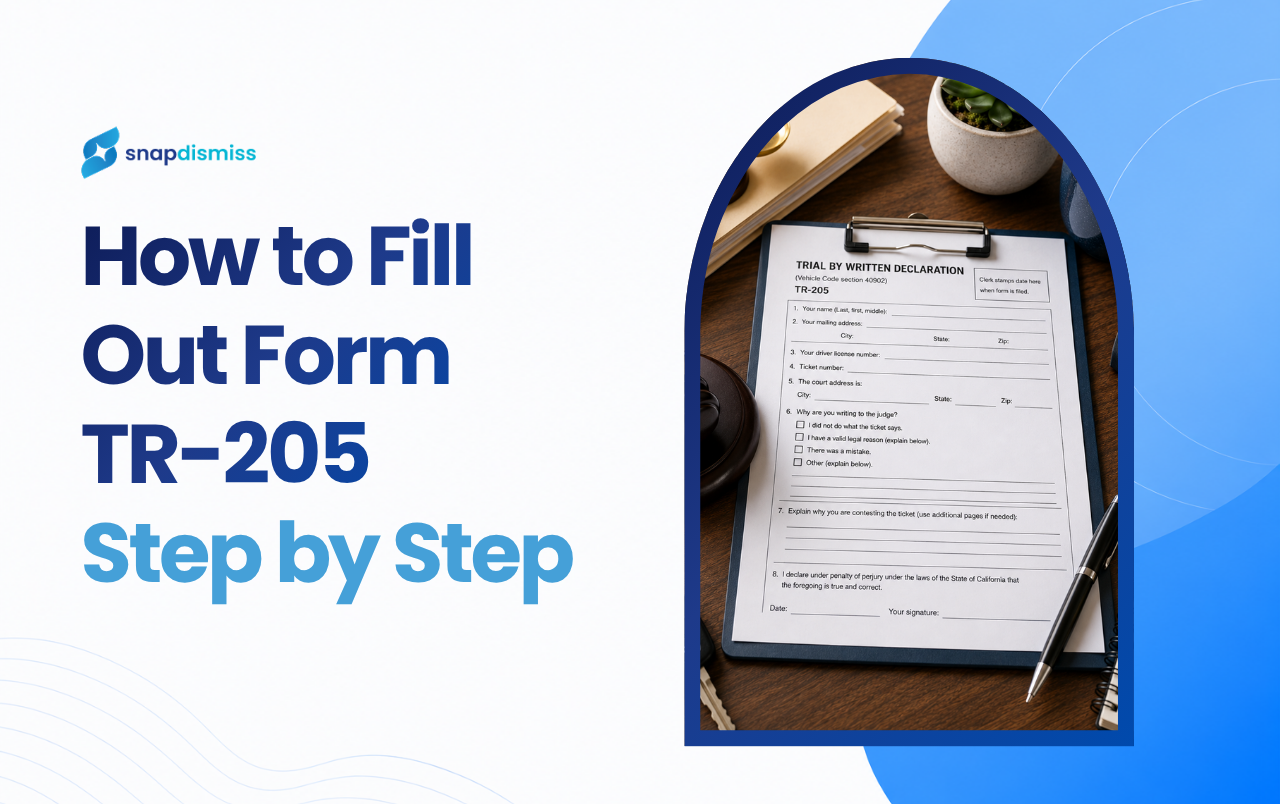
- Ask the court for Form TR-200 (Instructions to Defendant) and Form TR-205 (your declaration form) if not already provided.
Phase 3: Write Your Declaration of Facts
This is the section that determines your outcome. The Declaration of Facts on the reverse of Form TR-205 must be a legal argument, not a personal story.
Structure it like this:
- Opening: “I, [Full Name], declare under penalty of perjury: Citation No. [XXXXXX]. I plead Not Guilty.”
- Conditions at time and location: Precise road conditions, weather, visibility, traffic volume, and any relevant signage at the exact time and place.
- Detection method challenge: Reference the officer’s detection method and its technical requirements. Radar and LIDAR devices require calibration within specific intervals request the calibration log and reference gaps in it.
- Code-specific legal argument: State the CVC section and identify which required element the prosecution cannot prove. This is your core legal defense.
- Evidence references: Name each exhibit explicitly: “Exhibit A photograph taken [date] at [location] showing the 35 mph sign partially obscured by a tree branch.”
- Closing request: “I respectfully request the court find me Not Guilty and refund the full bail amount.”
For drivers who want this done precisely, automatically, and targeting their specific violation code, SnapDismiss’s AI-powered TR-205 generator produces this entire declaration in minutes legally structured and court-ready.
Phase 4: Submit Your Complete Package
Assemble your full submission:
- Completed, signed Form TR-205
- Declaration of Facts continuation pages on Form MC-031 (if needed)
- All evidence exhibits, labeled in order (Exhibit A, Exhibit B, etc.)
- Bail payment by check or money order payable to “Superior Court” never through the court’s online fine portal
Mail everything via certified mail with return receipt requested to the court’s mailing address (not street address). Keep a complete copy of your entire package plus the certified mail tracking number.
Phase 5: Act on the Decision Especially If You Lose
The court mails a Notice of Decision (Form TR-215) within 90 days. Two outcomes:
- Not Guilty / Dismissed: Full bail refund. No point. No insurance increase. Ticket gone.
- Guilty: File Form TR-220 within 20 calendar days of the mailing date for a Trial de Novo a completely fresh in-person trial before a different judge, with new evidence permitted. This second chance costs nothing to request and is your right under CVC Section 40902(d). Miss the 20-day window and it is gone permanently.
Self-Representation vs. Attorney vs. Paying: Honest Comparison
| Path | Cost | Time | Outcome Potential | Second Chance? |
|---|---|---|---|---|
| Pay the fine | $238–$900+ plus $900+/yr insurance increase | 5 min | ❌ Guaranteed conviction | ❌ No |
| Traffic school | Fine + school fees; conviction stays on record | Fine + 4–8 hrs | ⚠️ No dismissal point masked only | ❌ No |
| Attorney (infraction) | $200–$500 + conviction still possible | Meetings + coordination | ✅ Possible dismissal same TR-205 process | ✅ Yes (Trial de Novo) |
| Self-rep + TR-205 (SnapDismiss) | Fraction of attorney cost + bail refunded if won | Under 10 minutes active | ✅ Full dismissal possible | ✅ Yes (Trial de Novo) |
The honest truth: for standard moving infractions speeding, red light, stop sign, cell phone a California traffic attorney almost always files the same TR-205 you can generate yourself. You are paying $200–$500 for the process, not for exclusive expertise unavailable to you. An AI-powered platform puts that expertise in your hands at a fraction of the price.
Real Defenses That Win Without an Attorney
The strongest no-attorney defenses aren’t complicated. They target what the prosecution must prove and show the evidence doesn’t support it:
Defense 1: Challenge the Detection Method
Every speed measurement tool has calibration requirements. Radar guns must be calibrated regularly, with calibration logs maintained. LIDAR devices require operator certification and correct usage protocols. Pacing (following a vehicle) requires consistent distance and verified speedometer accuracy. Request all maintenance records when you plead not guilty. Gaps or expired certifications become powerful defense arguments.
Defense 2: Basic Speed Law (CVC 22350): Conditions, Not Just Numbers
California’s Basic Speed Law requires proof that the speed was unsafe for existing conditions not merely that you exceeded the posted limit. If road conditions were dry, visibility was clear, traffic was light, and no hazards were present, the prosecution cannot establish the core element of the violation. Document conditions precisely.
Defense 3: Signage Deficiency
Speed limit signs must be posted at legally required intervals, be of regulation size, and be clearly visible to approaching traffic. If foliage, a parked vehicle, a curve, or a hill blocked the sign document it immediately with photos. A citation cannot be sustained if the posted limit wasn’t reasonably visible to the driver.
Defense 4: Officer’s Observation Was Physically Unreliable
If the officer was stationary on a curve, parked behind a structure, or positioned at an angle that prevented accurate speed observation, this is a legitimate defense. A diagram showing the officer’s position relative to your vehicle and why accurate measurement was not possible from that location is powerful corroborating evidence.
Defense 5: Camera Ticket Procedural Violations
Red light camera tickets under CVC 21453(a) must meet strict procedural requirements: the Notice of Violation must be mailed within 15 days of the violation under CVC 40518, the camera system must have current calibration certification, and the registered owner must have actually been the driver. Failure on any of these points voids the citation.
How SnapDismiss Powers Self-Represented California Drivers
SnapDismiss is the AI-powered platform built to make self-representation as effective as professional representation for a fraction of the cost. Here is what it does for you:
- Instant eligibility check confirms in under 2 minutes whether your ticket qualifies for Trial by Written Declaration
- Violation code intelligence identifies the exact legal elements required for conviction under your specific CVC section and targets what’s missing from the prosecution’s case
- Court-ready TR-205 declaration generated automatically legally precise, correctly formatted, violation-specific arguments not a generic template
- Evidence reference formatting properly structures your exhibits so every photo and diagram carries maximum legal weight
- Deadline tracking never miss your court due date or your 20-day Trial de Novo window
- Full Trial de Novo guidance if your written declaration doesn’t produce a dismissal, SnapDismiss walks you step-by-step through your second chance
You don’t need three years of law school to win a traffic ticket case in California. You need to know the right process, target the right legal elements, and submit a document that reads like it was written by someone who knows what a judge is looking for. That’s what SnapDismiss delivers.
7 Mistakes That Turn a Winnable Case Into a Conviction
- Paying online before you understand what you’re paying. The court’s online portal in most counties processes payment as a fine a guilty plea. Bail for a written declaration must be submitted separately by check with your TR-205. These are not the same transaction.
- Writing about why you were justified instead of why the prosecution can’t prove guilt. The judge doesn’t evaluate your reasons. The judge evaluates whether the prosecution can prove each element of the violation beyond a reasonable doubt. Write to that standard, not to sympathy.
- Waiting until the last week to start. Your declaration needs to be researched, written, reviewed, and mailed with enough time for certified delivery. Start the same week you receive the ticket.
- Not photographing the scene immediately. Speed limit signs get replaced. Vegetation gets trimmed. Road markings fade. A photo taken the day after your citation is worth ten times more than a description written six weeks later.
- Forgetting the 20-day Trial de Novo deadline. This right is non-negotiable and non-extendable. The moment you receive your guilty verdict by mail, set an alert for day 20. File TR-220 before it expires.
- Leaving evidence unlabeled and unexplained. Attaching a photo without naming it “Exhibit A” and without explaining what it shows in your declaration means the judge may ignore it entirely.
- Assuming traffic school removes the ticket. It doesn’t. Traffic school masks the DMV point from your insurer for 18 months but the conviction remains on your record. A dismissed ticket through TR-205 eliminates it entirely.
Expert Tips for First-Time Self-Representatives
- Read your violation code before writing a single word. Every Vehicle Code section defines what must be proven. You cannot build a defense without knowing exactly what elements exist. Look up your specific CVC section on leginfo.legislature.ca.gov it takes 3 minutes and transforms your declaration.
- Be concise and precise not comprehensive. The best declarations are 1–2 pages. Judges review dozens of cases. A tight, legally targeted declaration that identifies one or two specific failure points in the prosecution’s case is more effective than a five-page narrative covering everything that happened that day.
- Request discovery from day one. Submit your discovery request the same day you plead not guilty. Calibration logs, officer notes, and bodycam footage must be provided under California’s discovery rules. A gap in any of these records is a gift.
- Confirm your court’s specific procedures. Some courts have local rules about format, submission method, or extension availability. Check your court’s Traffic Division website before you submit your online or mail-in defense.
- Think of your declaration as the prosecution’s weakness, not your explanation. The best self-represented defenses don’t tell the driver’s story. They identify what the officer cannot prove and demonstrate why with facts and evidence. This shift in framing is the single biggest difference between declarations that win and declarations that don’t.
Frequently Asked Questions: No-Attorney Traffic Ticket Defense in California
Do I really need an attorney to fight a California traffic ticket?
No. California’s Trial by Written Declaration process under CVC 40902 is specifically designed for self-represented drivers. California’s own DMV Handbook states that attorney representation is not required. For standard traffic infractions speeding, red light, stop sign, cell phone, lane change thousands of California drivers successfully contest and dismiss their tickets every year without ever hiring an attorney.
What are my realistic chances of winning without an attorney?
Studies of California TBWD cases suggest approximately 25–30% are dismissed solely because the officer never responds. Beyond that, a well-constructed, legally targeted declaration that specifically challenges the elements of your violation code improves your odds significantly. California does not publish official statewide success rates, but per-violation data suggests strong dismissal rates for Basic Speed Law violations, red light camera tickets, and stop sign violations when properly contested.
When does it make sense to hire an attorney for a traffic ticket?
An attorney is worth the investment when the stakes exceed what TR-205 covers: misdemeanor charges (DUI, reckless driving, hit-and-run), any “Must Appear” citation, violations involving an accident with injury or property damage, speeding over 100 mph subject to the FAST program, or any violation that threatens a Commercial Driver’s License. For standard moving infractions, an AI platform like SnapDismiss delivers comparable defense quality without the $200–$500 attorney fee.
What is the Trial by Written Declaration and how does it work?
A Trial by Written Declaration (TR-205) is a legal process under California Vehicle Code Section 40902 where you submit a sworn written defense along with evidence and bail to the court by mail. The officer may also submit a written statement. A judge reviews both sides and mails a decision within 90 days. If the officer doesn’t respond, the case is typically dismissed. If you lose, you have 20 calendar days to request a new in-person trial called a Trial de Novo.
What happens if I lose my written declaration?
A guilty verdict on your TR-205 is not the end of the road. Under CVC Section 40902(d), you are entitled to request a Trial de Novo a completely fresh in-person trial before a different judge by filing Form TR-220 within 20 calendar days of the mailed decision date. No prior declarations are considered. You can bring new evidence and witnesses. The officer must appear in person. Traffic court is the only court in California where you can legally fight the same case twice.
Can I use SnapDismiss without any legal knowledge?
Yes. SnapDismiss is designed specifically for California drivers with no legal background. You enter your citation details violation code, detection method, court, date, location and the platform’s AI analyzes your specific CVC section, identifies the strongest legal arguments, and generates a complete, court-ready TR-205 declaration. You review it for accuracy, sign it under penalty of perjury, attach your evidence and bail, and mail it. No legal knowledge required. No attorney needed.
Is the Trial by Written Declaration available in all California counties?
Yes. The mail-in Trial by Written Declaration (TR-205) is available in all 58 California Superior Courts for eligible infraction-level citations. Some courts also offer an online version through the MyCitations portal, though that platform is only available in select counties and may affect your Trial de Novo rights always confirm with your specific court before choosing the MyCitations path over the standard mail-in TR-205 process.
No Attorney Required Start Your Defense in Under 10 Minutes
Thousands of California drivers dismiss their own tickets every year with no attorney, no courtroom, and no legal degree. They use a process California built specifically for them the Trial by Written Declaration and they do it on a Sunday afternoon from their kitchen table.
The only difference between those drivers and the ones who pay the fine and absorb the insurance increase is knowing the process exists and starting before the deadline.
SnapDismiss makes that process faster, smarter, and more effective than doing it alone. Enter your citation. Get your defense. Mail it in. That’s it.
Check your eligibility with SnapDismiss right now before your deadline turns a winnable case into a guaranteed conviction.
Disclaimer: This article is for general informational purposes only and does not constitute legal advice. SnapDismiss is not a law firm and does not provide legal representation. For advice specific to your situation, consult a licensed California attorney. See the full SnapDismiss disclaimer.