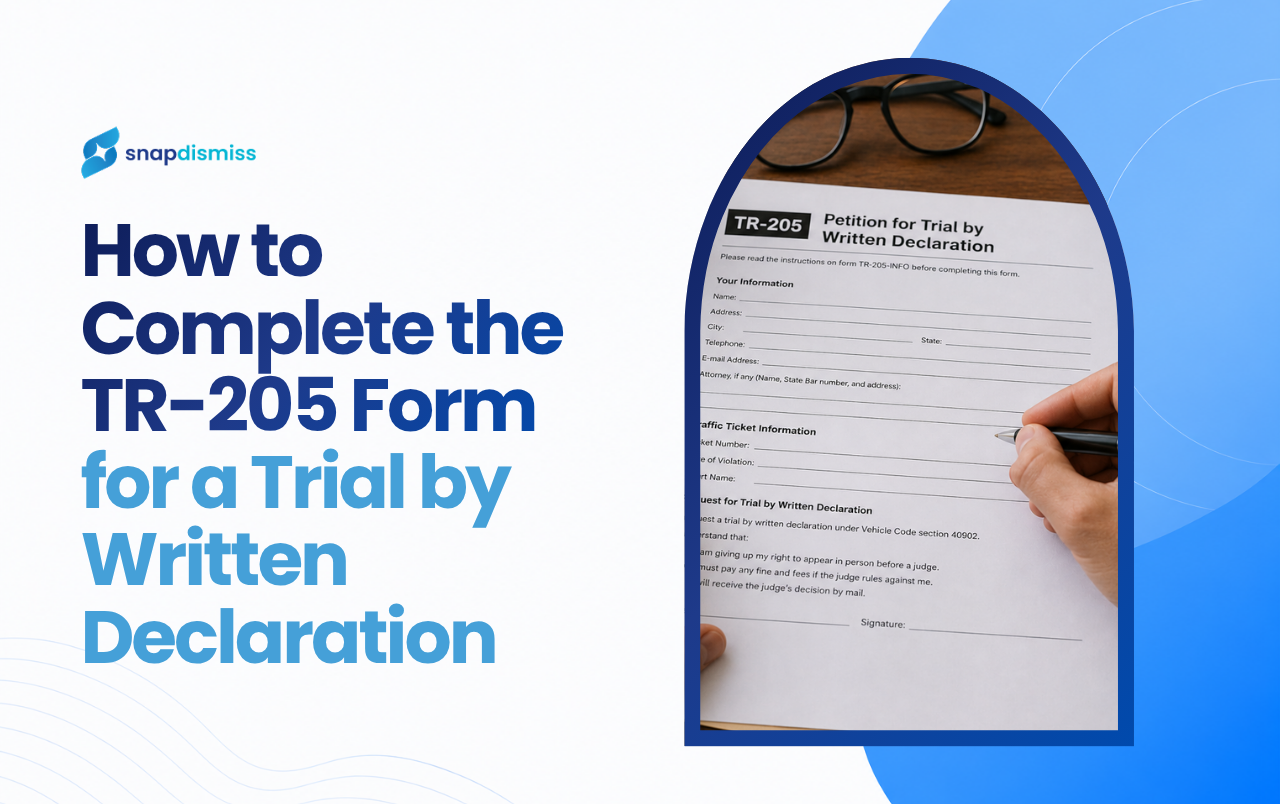
How to Complete the TR-205 Form for a Trial by Written Declaration
You’ve decided to fight your California traffic ticket. Smart move. Now you’re staring at a PDF called TR-205 and wondering: What goes in each box? What do I write in the Statement of Facts? How do I list evidence? What can I do to avoid getting this rejected?
You’re in the right place. The TR-205 form officially titled Request for Trial by Written Declaration is the Judicial Council of California document that lets you contest a traffic citation entirely by mail. Fill it out correctly and you have a genuine shot at full dismissal. Fill it out wrong and the court either rejects your filing or a judge rules against you before you’ve had a fair chance.
This guide walks you through every section, field by field, with clear instructions on exactly what to write and what to never include. If you’d prefer to skip the manual work entirely, SnapDismiss generates a court-ready TR-205 declaration in minutes from your citation details.
What Is the TR-205 Form?
The TR-205 is a Judicial Council of California form that initiates a Trial by Written Declaration under California Vehicle Code Section 40902. It is the official document through which a driver charged with a traffic infraction formally requests that their case be decided by a judge in writing no courtroom, no in-person appearance required.
Once submitted with bail, the court notifies the citing officer, who may also submit a written statement. A judge reviews both sides and mails a decision known as the Notice of Decision, Form TR-215 typically within 30 to 90 days.
The form itself has two sides: the front page captures your identifying information, citation details, evidence list, and your signed request and the reverse side (Section 6) is where your Declaration of Facts goes. This is where the case is made or lost.
Before You Touch the Form: What to Gather First
Rushing to fill out a TR-205 without the right information in front of you is the fastest route to errors. Before you open the form, have these items on your desk:
- Your original traffic citation (or a court-issued courtesy notice if you’ve received one)
- The name and mailing address of the court handling your case printed on the citation or on the court’s website
- Your citation number and case number (if assigned)
- The bail amount contact the court or check their website if it isn’t printed on the notice
- Your Vehicle Code violation section the specific CVC number on your ticket
- The officer’s detection method radar, LIDAR, pacing, visual estimate, or camera
- Any evidence you plan to attach photos, maps, diagrams, dashcam screenshots, calibration record requests
- A check or money order made out to “Superior Court” for the bail amount
Also read Form TR-200 (Instructions to Defendant) first. You’re required to confirm on the TR-205 that you’ve read it so actually reading it before you fill out the form is both legally required and practically useful.
How to Fill Out the TR-205 Form: Section by Section
Here is every field of the TR-205 form for a Trial by Written Declaration, explained clearly and completely.
Section A Court Information (Top of Page)
These fields identify which court is handling your case. Every line must be filled in accurately or your submission may be routed incorrectly.
| Field | What to Enter |
|---|---|
| Name of Court | Full name of the California Superior Court handling your case (e.g., “Superior Court of California, County of Los Angeles”) |
| Street Address | Physical street address of the specific court branch |
| Mailing Address | Mailing address if different from street address often it is. Use the mailing address for sending your package. |
| City and Zip Code | City and ZIP of the court |
| Branch Name | The specific branch (e.g., “Stanley Mosk Courthouse” or “Airport Courthouse”). Find this on your citation or courtesy notice. |
Common mistake: Using the court’s street address for mailing. Many California courts have a separate P.O. Box or mailing address. Always verify on the court’s official website before mailing.
Section B Case Caption (“People v. Defendant”)
Just below the court address block, you’ll see a case caption formatted as “PEOPLE OF THE STATE OF CALIFORNIA vs. [Defendant Name]”.
- Defendant Name: Enter your full legal name exactly as it appears on your driver’s license and on the citation.
Section C For Court Use Only Fields
You’ll see several boxes marked For Court Use Only including the Case Number, Bail Amount Required, and Date Mailed or Delivered by Clerk. Leave these blank. The court clerk fills these in when they process your submission. Do not write anything in these fields.
Exception: If your courtesy notice includes a pre-assigned case number, enter it in the Citation Number field to help the clerk match your filing to the correct record.
Section 1 Citation Number
Enter your citation number exactly as printed on your traffic ticket. This is typically found in the upper right corner of the citation. For red light camera tickets, it may be labeled “Automated Enforcement Number.” Do not guess or transpose digits an incorrect citation number can prevent the court from locating your case.
Section 2 Personal Information
| Field | What to Enter |
|---|---|
| Name | Your full legal name (first, middle if applicable, last) |
| Current Mailing Address | The address where you want the court to mail the decision must be current and deliverable |
Use a reliable mailing address. If the court’s decision is mailed to an outdated address and you miss the 20-day window to request a Trial de Novo, you lose that right permanently.
Section 3 Acknowledgment Checkboxes
You must confirm three things by initialing or checking the appropriate boxes:
- I have reviewed the Instructions to Defendant (Trial by Written Declaration) (form TR-200). Check this box. This is why reading TR-200 first matters; you’re certifying it under oath.
- I request to have a trial by written declaration. Check this box. This is your formal invocation of your CVC 40902 right.
- The facts contained in the Declaration of Facts on the reverse are personally known to me and are true and correct. This is a sworn statement. Everything in your Section 6 declaration must be truthful. False statements made under penalty of perjury carry serious legal consequences.
Section 4 Waiver of Right Against Self-Incrimination
The form includes a notice that by submitting a written statement, you are voluntarily waiving your Fifth Amendment right not to be compelled to testify against yourself. You acknowledge and agree to this by proceeding. This is normal and expected it applies to every written declaration. It simply means the statement you provide can be considered as evidence in the case.
Section 5 Evidence (The Checklist)
This is a checklist of evidence types you are attaching to your submission. Check every box that applies to your case and list each piece explicitly. The form typically includes checkboxes for:
- Photographs
- Diagrams
- Medical records (if relevant e.g., medical emergency defense)
- Car repair receipts (relevant for fix-it ticket defenses)
- Registration documents
- Insurance documents
- Inspection certificates
- Other (specify) use this for calibration records, witness statements on MC-031, dashcam screenshots, Google Maps printouts, etc.
Critical rule: Every piece of evidence you check in Section 5 must be explicitly referenced by name in your Section 6 Declaration of Facts. Do not attach exhibits that your declaration never mentions the judge won’t know why they’re relevant. And do not reference evidence in your declaration that you haven’t listed in Section 5 it may be ignored entirely.
At the bottom of Section 5, write the total number of additional pages attached. Count carefully one missed page can cause a mismatch that flags your submission for administrative review.
Section 6 Declaration of Facts (The Reverse Side Your Case)
This is the heart of your entire submission. Everything else is procedural. Section 6 is where you actually defend yourself.
The form instructs: “Type or print only. State what happened and explain all the items of evidence you checked in item 5 and tell how they support your case. You may add additional pages.”
Use Form MC-031 (Attached Declaration) if you need more space. This is standard and expected for any substantive defense.
What to include in your Declaration of Facts:
- Opening identification “I, [Full Name], hereby declare under penalty of perjury that the following facts are personally known to me and are true and correct. Citation Number: [XXXXXX]. I plead Not Guilty.”
- Date, time, and location of the alleged violation be precise, not approximate
- Road and environmental conditions weather, traffic density, visibility, road surface, lighting
- What you were doing describe your driving behavior factually, referencing specific Vehicle Code elements the prosecution must prove
- Challenge to detection method if the officer used radar or LIDAR, reference the calibration requirements; if pacing, describe why the officer’s position made accurate measurement impossible
- Evidence references for every exhibit attached, name it and state exactly what it shows: “Exhibit A is a photograph taken on [date] at [location], showing that the 35 mph speed limit sign is obstructed by an oak tree branch, rendering it not reasonably visible from the eastbound approach lane.”
- Specific legal argument reference the Vehicle Code section and identify which element cannot be established: “Under CVC 22350, the prosecution must prove the speed was unsafe for conditions. The weather was clear, road conditions were dry, traffic was light, and no hazards were present.”
- Closing request “For the foregoing reasons, I respectfully request that this court find me Not Guilty and refund the full bail amount deposited.”
Section 7 Signature, Date, and Perjury Declaration
At the bottom of the form (and at the end of any MC-031 continuations), you must:
- Write today’s date
- Sign your full legal name in the signature field
- Print your name below the signature
The perjury statement reads: “I declare under penalty of perjury under the laws of the State of California that the foregoing is true and correct.” This applies to everything you have written in both Section 6 and any attached pages. Every witness statement on MC-031 must also include this declaration and a separate signature from the witness.
Complete TR-205 Submission Checklist
Before sealing your envelope, verify every item below. A single missing component can delay processing or result in a default ruling against you.
| Item | Status |
|---|---|
| Form TR-205 fully completed all fields filled in, no blanks except “Court Use Only” | ☐ |
| Section 6 Declaration of Facts written, typed, or printed signed and dated | ☐ |
| MC-031 continuation pages attached and signed (if needed) | ☐ |
| All evidence exhibits attached, clearly labeled (“Exhibit A,” “Exhibit B,” etc.) | ☐ |
| Number of attached pages counted and entered in Section 5 | ☐ |
| Bail payment by check or money order payable to “Superior Court” citation number and “Not Guilty” written in memo line | ☐ |
| Copies made of the entire package for your records | ☐ |
| Package mailed via certified mail, return receipt requested, to the court’s mailing address (not street address) | ☐ |
| Mailing date is no earlier than 7 days before your due date and arrives before the due date | ☐ |
7 Critical TR-205 Mistakes That Get Declarations Rejected or Lost
- Paying online instead of submitting bail by check. The court’s online payment portal almost always processes the payment as a fine closing the case as a guilty plea. Bail must accompany your TR-205 by check or money order.
- Writing a vague or emotional Declaration of Facts. “I don’t think I was speeding” or “I was only slightly over the limit” are not legal defenses. Write specific, factual, code-referenced arguments only.
- Using the street address instead of the mailing address. Many California Superior Courts have different mailing addresses. Using the wrong address means your package may sit unprocessed or be returned and the clock doesn’t stop.
- Leaving the citation number blank or entering it incorrectly. Without a correct citation number, the court cannot match your submission to your case. Your filing effectively disappears into administrative limbo.
- Attaching evidence without referencing it in the Declaration of Facts. An unlabeled photo attached to a TR-205 without explanation carries zero weight. Every exhibit must be named and explained in your declaration.
- Forgetting to sign both the TR-205 front page and any MC-031 continuation pages. An unsigned declaration is procedurally defective. The court may reject it outright or treat it as if it was never filed.
- Submitting too late or too early. The submission must arrive at the court clerk by the due date. Mail it at least 5–7 days early. But don’t send it weeks in advance best practice is one week before the deadline.
Expert Tips: Writing a Declaration That Stands Out
- Type your declaration never handwrite it. Handwritten declarations are harder to read and give an impression of informality. Typed submissions on MC-031 continuation pages look professional and are easier for the judge to follow.
- Open with the Vehicle Code section you’re charged under. State it in your first paragraph: “I am charged with a violation of CVC 22350. Under this code, the prosecution must prove that my speed was unsafe for conditions at the time. The following facts demonstrate that no such proof exists.”
- Challenge what the officer cannot prove not what you think happened. The best declarations don’t tell your story; they identify the gaps in the officer’s story. What can’t they prove? Detection method limitations, sight line obstructions, sign visibility these are far stronger than personal accounts.
- Photograph the scene within 24–48 hours of the citation. Conditions change. Get dated, geotagged photos as soon as possible. Courts give significantly more weight to contemporary photographic evidence than to descriptions written weeks later.
- Use SnapDismiss to build your declaration framework. SnapDismiss identifies your exact violation code, maps it to the elements the prosecution must prove, and generates a structured TR-205 declaration built around your specific citation in minutes. It’s the difference between a generic letter and a legally targeted defense document.
Where to Get the Official TR-205 Form
Always use the official, current version of the TR-205 from an authoritative source. Third-party versions may be outdated. Get it from:
- California Courts Official Website: selfhelp.courts.ca.gov/jcc-form/TR-205
- Your specific court’s website many counties post the form directly on their Traffic Division page
- In person at the court clerk’s window available free of charge
Once you’ve verified your eligibility and are ready to begin, you can also use SnapDismiss to handle the TR-205 preparation for you generating the Declaration of Facts, formatting the form correctly, and ensuring every legal element is addressed before you send it.
Frequently Asked Questions About the TR-205 Form
What is the TR-205 form used for?
The TR-205 form is used in California to request a Trial by Written Declaration a process under California Vehicle Code Section 40902 that allows drivers to contest a traffic infraction entirely in writing, without appearing in court. The defendant submits the form with a sworn statement of facts, supporting evidence, and a bail deposit. A judge reviews the written submissions and mails a decision.
Where do I get the TR-205 form?
Download the official current version from the California Courts self-help website at selfhelp.courts.ca.gov/jcc-form/TR-205, or pick one up in person at the clerk’s window of the court handling your case. Always use the official Judicial Council version third-party reproductions may be outdated or formatted incorrectly.
What should I write in the Statement of Facts on the TR-205?
Your Statement of Facts (Section 6) should contain a factual, chronological account of the alleged violation including precise road conditions, weather, traffic, signage, and the officer’s detection method. Most importantly, it must reference the specific Vehicle Code section you’re charged under and identify which legal element the prosecution cannot prove. Attach evidence and reference each exhibit by name. Avoid emotional language, personal excuses, or admissions of guilt. If you need more space, continue on Form MC-031.
Can I handwrite the TR-205 form?
Yes, the form instructs you to “type or print only” in Section 6. Both are technically acceptable, but typing is strongly recommended. A typed declaration is clearer, easier for the judge to read, and presents a more professional, credible appearance. For best results, type your declaration on MC-031 continuation pages and write “Please see attachments” in the Section 6 space on the TR-205 itself.
Do I have to pay when I submit the TR-205 form?
Yes. Under California Vehicle Code Section 40902, you must submit the full bail amount (equal to the fine amount) with your TR-205. This is not a payment of the fine it is a deposit held in trust. If you win or the case is dismissed, the full amount is refunded to you. Submit bail by check or money order made payable to “Superior Court.” Do not pay via the court’s online portal, as that typically processes as a fine a guilty plea not as bail.
What happens if I make a mistake on the TR-205 form?
Minor errors a crossed-out word, a small correction are generally acceptable if they don’t affect the substance of the filing. However, structural errors (wrong citation number, missing signature, no bail, wrong court address) can cause the court to reject your submission or proceed without your defense. Always make a clean copy, review every field, and keep a complete copy of your package before mailing. If you’re concerned about errors, platforms like SnapDismiss generate verified, correctly formatted TR-205 submissions that eliminate common filing mistakes.
What if my TR-205 is rejected by the court?
If your submission is rejected, the court typically notifies you by mail with a reason. Common rejection causes include: wrong bail amount, missing signature, incorrect form version, or submission after the due date. If rejected for a correctable reason before the deadline, you may be able to resubmit. If rejected after the deadline, your options narrow significantly contact the court clerk immediately to understand your remaining options. This is exactly why submitting several days early with certified mail tracking is so important.
Ready to Complete Your TR-205 Form? SnapDismiss Can Do It For You.
The TR-205 form is not complicated but the Declaration of Facts section is. Writing a legally targeted, evidence-backed statement that directly challenges the elements of your specific violation code is the difference between a dismissal and a conviction. And most drivers who fill it out themselves get that section wrong.
You don’t have to.
SnapDismiss handles the entire TR-205 process for you checking your eligibility, analyzing your violation code, identifying your strongest legal arguments, and generating a complete, court-ready declaration package in minutes. No legal background needed. No hours of research. Just a professionally prepared defense, ready to mail.
Check your citation eligibility now. Before your deadline.
Disclaimer: This article is for general informational purposes only and does not constitute legal advice. Individual circumstances vary. For advice specific to your case, consult a licensed California attorney. See the full SnapDismiss disclaimer for details.